How to Launch on Product Hunt in 2026: A No-BS Playbook for Founders
A no-BS Product Hunt launch playbook for 2026: what to do 4–6 weeks before launch, how to execute the 24-hour window, and how to monetize after.

Most Product Hunt launches fail after the traffic spike dies.
Founders celebrate hitting top 5, then watch their MRR stay at zero 30 days later.
The difference between launches that convert and launches that fizzle isn't luck. It's a system.
After helping 30+ Web3 and AI startups launch on Product Hunt, we identified a clear pattern: top performers optimize for conversion, not ranking. They treat PH as a distribution event, not a vanity play.
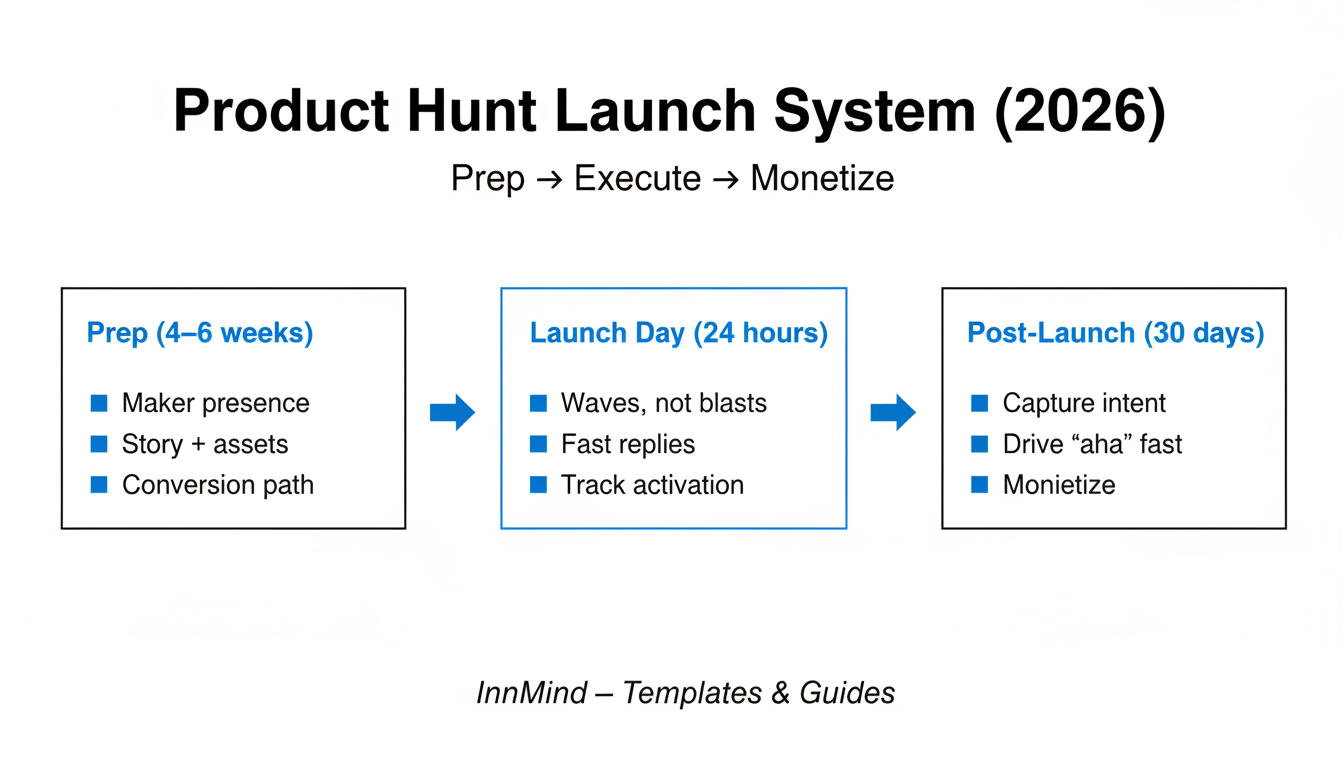
This guide covers the complete system: what to do 4–6 weeks before launch, how to execute the 24-hour window without triggering spam filters, and most importantly - how to monetize the traffic spike over 30 days.
Whether you're launching your first product or re-launching after a failed attempt, this playbook works for AI tools, Web3 platforms, dev tools, and any technical product where trust beats hype.
If you think Product Hunt is "submit at midnight PT + ask friends to upvote," you're going to have a bad time in 2026.
Yes - Product Hunt can still produce a real spike. But the teams that get lasting value (users, revenue, partnerships, investor credibility) treat it like an actual launch campaign:
- 4–6 weeks of preparation
- a 24-hour execution plan
- and a 30-day conversion + monetization sprint afterwards
This post gives you the high-level system I’d use if I were launching a startup today - especially if you’re AI, Web3, dev tools, or anything “technical” where trust and onboarding matter more than hype.
And if you want the step-by-step timeline, copy/paste checklists, launch-day wave schedule, and the full post-launch monetization playbook, we packaged it into a paid PDF: Product Hunt Launch Guide 2026 (built from recent launches and what actually works now).
TL;DR (for busy founders)
To win on Product Hunt in 2026:
- Prep early: build presence + assets + a narrative that makes sense in 10 seconds
- Launch with structure: plan outreach in timed waves, focus on real comments/feedback, don’t trigger spam patterns
- Monetize fast: capture the spike, drive users to an “aha moment,” and convert within 30 days
If you’re launching within the next 30–60 days, don’t improvise it - use a checklist-driven plan.
Common Product Hunt Launch Questions (Quick Answers)
Q: When is the best day to launch on Product Hunt?
A: Tuesday through Thursday typically perform best. Avoid Mondays (low engagement), Fridays (weekend drop-off), and major holidays. Check Product Hunt's upcoming schedule 2 weeks ahead to avoid launching against major competitors.
Q: How many upvotes do you need to reach top 5?
A: In 2026, expect ~200-350 upvotes for top 5 position, depending on launch day competition. However, ranking shouldn't be your primary goal—conversion rate matters more than ranking position.
Q: Should you use a Product Hunt hunter?
A: Only if you have a hunter who is actively engaged in your product category and has genuine interest. A hunter doesn't magically add distribution—your assets, narrative, and execution matter far more than hunter reputation.
Q: What's the #1 reason Product Hunt launches fail?
A: No post-launch conversion system. Most founders stop optimizing after launch day. Winners have a structured 30-day plan to convert traffic into users, activated customers, and revenue.
Q: Can B2B SaaS and developer tools succeed on Product Hunt?
A: Yes, if onboarding delivers value in under 2 minutes. Products requiring "book a demo" calls or lengthy enterprise sales cycles typically underperform on Product Hunt.
Q: What's a realistic conversion rate from Product Hunt traffic?
A: Top-performing launches convert 15-25% of visitors into signups, 35-45% of signups into activated users within 7 days, and 5-10% of activated users into paying customers within 30 days. If you're below these benchmarks, your funnel needs work.
What Changed on Product Hunt's Algorithm in 2026?
What didn’t change: Product Hunt is still a community. People reward products that look legit, feel useful, and have a clear narrative.
What changed: the platform has become much better at filtering low-quality, spammy, or “manufactured” launches. That means:
- “Upvote chasing” is a bad strategy.
- New accounts created right before launch are weak signals.
- Sudden vote spikes can look suspicious.
- Generic comments (“Great project!”) don’t help.
If you want one mental model: Product Hunt rewards consistent momentum and authentic engagement — not brute-force blasts.
Consistent momentum beats brute force blasts. The platform now filters upvote rings and sudden spikes. Winners build engagement in timed waves, not mass outreach.
Product Hunt Launch Benchmarks (2026)
From launches we've tracked and advised:
Pre-launch preparation impact:
- Launches with 4+ weeks structured prep show 2.5-3x better conversion rates than rushed launches
- Engaging with 10+ relevant PH launches before your own correlates strongly with better community reception
- Having a clear "first value delivered in under 2 minutes" onboarding flow is the #1 predictor of signup-to-activation success
Launch day execution patterns:
- Staggered outreach in 4-5 waves outperforms single mass blast by 2-3x in sustained engagement
- First maker comment posted within 5 minutes of launch: 85%+ correlation with reaching top 10
- Reply time under 15 minutes to comments: strong positive signal for community engagement scoring
Red flags that hurt ranking or trigger review:
- 20+ upvotes appearing in first 10 minutes (looks artificial, triggers manual review)
- Comment-to-upvote ratio below 1:20 (suggests vote manipulation)
- Multiple new accounts created within 7 days of launch giving upvotes (low signal weight)
Post-launch conversion reality check:
- Day 1-3 typically drives 60-75% of total Product Hunt traffic
- Day 1 signup conversion: 8-15% of visitors (if lower, your landing page needs work)
- Activation within 7 days: 30-50% of signups (if lower, onboarding is broken)
- Conversion to paid within 30 days: 5-12% of activated users (benchmark for product-market fit)
These benchmarks apply primarily to AI tools, dev tools, and Web3 platforms. Consumer apps and enterprise products show different patterns.
What Should Your Product Hunt Launch Goal Be?
Step 1: Define your goal (or Product Hunt will define it for you)
Before you touch your assets or outreach list, answer one question:
What do you want Product Hunt to do for your business?
Pick one primary outcome:
- Users / signups (most common)
- Revenue (paid plans, preorders, pilots)
- Distribution (partnerships, newsletter mentions, communities)
- Credibility (PR, investor social proof)
If you don’t choose, you’ll default to the vanity metric of “rank” - and then hate your life when the spike dies 48 hours later.
A Product Hunt launch is not a growth strategy. It's a distribution event. Your job is to convert that 24-hour attention spike into a 30-day monetization system - or watch it evaporate.
How to Prepare for Product Hunt Launch (4-6 Weeks Before)
Step 2: The prep. work that makes launch day easy
Most founders do two things:
- panic the week before launch
- blame Product Hunt when it doesn’t work
The winners treat pre-launch as a project. Here’s the high-level plan.
2.1 Build presence (without being cringe)
The goal is not “become famous.” The goal is to look like a real maker and avoid looking like a one-day spammer.
High-level moves that work:
- Create/refresh your maker profile early (photo, product story, links)
- Engage with launches in your category weeks before
- Leave thoughtful comments (actual feedback, not promo)
- Follow relevant makers and be visibly part of the ecosystem
This creates a baseline of trust. It also naturally builds a small network of people who will recognize your launch.
2.2 Refine your narrative (10 seconds or you lose)
On launch day, most people will see:
- your thumbnail
- your tagline
- your first screenshot
That’s it.
You need a narrative that answers in plain English:
- What is it?
- Who is it for?
- What problem does it kill?
- What’s the “wow” moment?
If you’re AI or Web3, you have an extra constraint: skepticism. People assume vaporware. Your job is clarity.
2.3 Prepare your listing assets (this is where launches are won)
Your assets are not decoration. They are your conversion system.
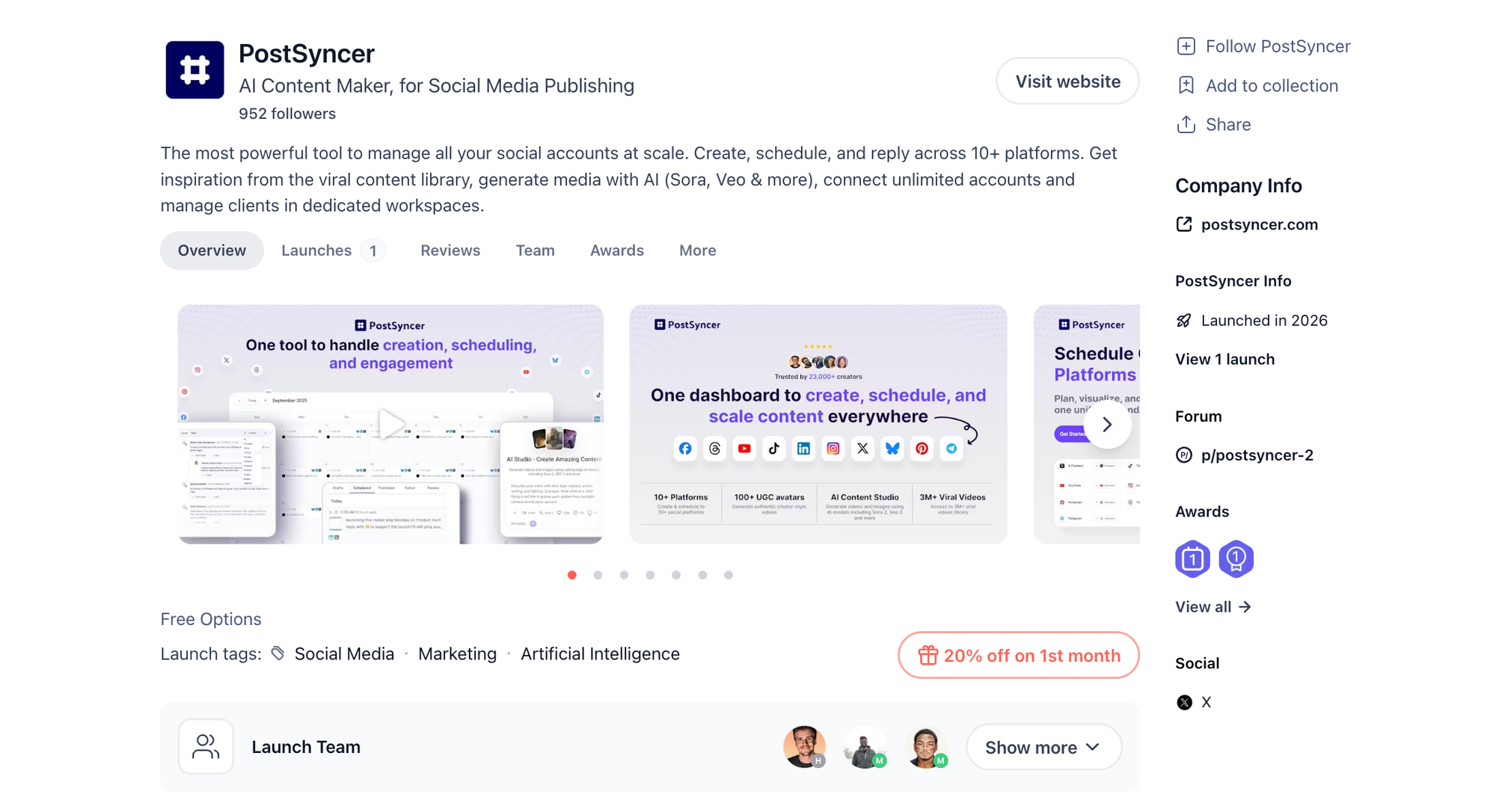
Minimum you should have:
- a clean thumbnail (legible on mobile)
- a hero image that shows the product in context
- 4–6 screenshots that tell a story
- a short demo video / GIF that shows the “aha moment”
- a landing page that loads fast and has one clear next step
Mini-checklist (assets):
- Does the first screenshot show outcome or just UI?
- Can someone understand the product in 5–10 seconds with sound off?
- Do you have one obvious CTA (signup / demo / join waitlist / start trial)?
- Is onboarding friction low (no “book a call” wall unless you’re enterprise-only)?
In our paid guide we include an assets checklist and examples of what to show for AI tools, dev tools, and Web3 products.
2.4 Warm up supporters (without triggering spam)
You can mobilize your network — but the “ask” matters.
The wrong ask:
“Please upvote us on Product Hunt!”
The right ask:
“We’re launching on PH on [date]. If you can, check it out and leave honest feedback — thoughtful comments help us improve.”
Real feedback + real comments are healthy. “Vote ring behavior” is not.
2.5 Collect followers and build a small launch list
You don’t need 10,000 people. You need:
- a concentrated group of relevant supporters
- across time zones
- who can show up in waves, not all at once
Build:
- a shortlist of friends + founder peers + customers + community members
- a segmented list (US, EU, APAC)
- a reminder plan (not spammy; just organized)
2.6 Pick PH launch day and time like a strategist
Product Hunt is global, but its day resets at midnight Pacific Time.
This matters because you’re trying to create momentum that looks organic:
- early traction (base layer)
- morning wave (US)
- mid-day wave (EU/US overlap)
- late wave (closing)
We map this out in detail in the guide, including what to do in each time window.
2.7 Hunter or not?
If you have a strong hunter who is relevant and engaged, it can help distribution. If not, launching yourself is fine.
The real lever is not “hunter magic.” It’s assets + narrative + execution + post-launch conversion.
How to Execute Product Hunt Launch Day Without Getting Filtered?
Step 3: Launch day: don’t do one big blast
The fastest way to kill your launch is to send one massive message to everyone at the same time.
That creates:
- unnatural spikes
- low-quality engagement
- and a messy comment section
Instead, treat launch day like a campaign with timed execution.
Founder note (real case from InnMind network): why some PH upvotes/comments “don’t show up” immediately
In a recent launch on Product Hunt we helped with, several real people (friends, peers, customers, even InnMind team) upvoted and left thoughtful comments to support the project, and many of them appeared only 60–90 minutes later, while others didn’t seem to count at all during the launch window.
We can’t prove the exact mechanics, but the pattern was consistent:
new accounts and long-inactive accounts were more likely to be delayed or filtered by PH algos.
Practical takeaway: don’t rely on “last-minute signups.” Build support early, encourage supporters to engage on Product Hunt before your launch, and prioritize genuine comments/feedback over brute-force upvoting.
In our guide, we include a “supporter warm-up” checklist specifically designed to reduce filtered or delayed engagement.
PH Launch day principles (high-level)
- Be present all day. The comments are part of the product.
- Stagger outreach. Waves beat blasts.
- Ask for feedback, not votes.
- Convert fast. The best comment is a user who signed up and tried the product.
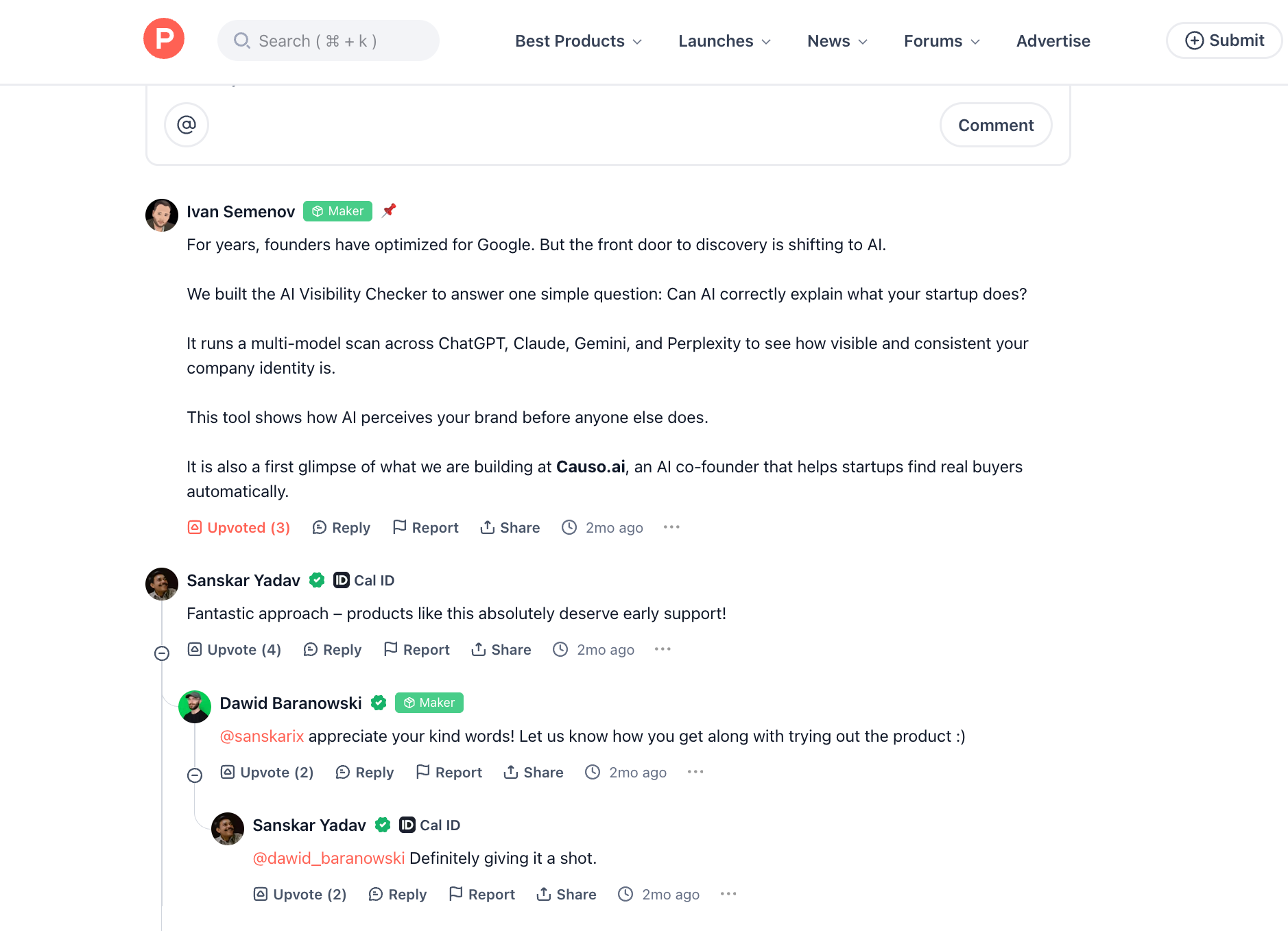
A good example on a screenshot above is from AI SDR startup Causo that launched on PH in 2025. Founders kicked off with the first comment right after the launch, and continued replying all comments & engaging with users' feedback during the whole launch day.
Mini-checklist (launch day)
- First maker comment ready (short story + who it’s for + what’s new)
- 3–4 outreach waves scheduled (not one)
- People assigned to reply to comments within minutes
- Social proof prepared (small: testimonials, metrics, credible logos)
- Landing page conversion path tested (mobile + desktop)
The paid guide includes an hour-by-hour launch day timeline (00:01–24:00 PT) with exactly what to do and when.
How to Monetize Product Hunt Traffic in 30 Days?
Step 4: Post-launch tactics: where revenue is made
The uncomfortable truth is:
Most Product Hunt launches don’t fail on Product Hunt. They fail after Product Hunt, because founders don’t convert the spike.
Post-launch is where you:
- capture intent
- activate users
- and monetize
4.1 Day 0–2: capture the spike without losing people
Your only job is to prevent leakage.
Do this:
- send a welcome email that gets users to the “aha moment”
- reduce friction (SSO, simple onboarding, skip steps)
- add a “new from Product Hunt” onboarding path if relevant
4.2 Day 1–14: from signup to “aha”
If you don’t know what your “aha moment” is, find out now.
Ask:
- What is the first real result users get?
- How fast can they get it?
- What blocks them?
In AI products, “aha” is often:
- first output that feels magical
- first workflow automation
- first saved hour
In Web3 products, “aha” must include trust:
- clear explanation
- transparent pricing
- minimal wallet friction
- safe defaults
4.3 Day 3–30: monetize with two tracks
The simplest monetization model after Product Hunt usually fits one of two tracks:
Track A: Self-serve (AI SaaS / tools)
- tighten onboarding → upgrade prompt → pricing clarity → annual plan
Track B: Sales-assisted (B2B / enterprise / infra)
- capture qualified leads → fast demo loop → pilot offer → close
The mistake is waiting. Product Hunt traffic is hottest in the first days. You need a 30-day plan.
This is where our guide goes deep: we include a full post-launch monetization playbook + a copy/paste checklist.
What Makes AI and Web3 Product Hunt Launches Different?
If you’re in AI or Web3, your biggest enemy is not competition — it’s skepticism.
So you win by making your listing feel safe:
- show the product working (not just “vision”)
- show what it does in one sentence
- show why it’s different in one sentence
- show a clear path to value in under 2 minutes
And please: no “mystery marketing.” Product Hunt users punish vagueness.
What Are the Biggest Product Hunt Launch Mistakes in 2026?
- Launching without a conversion path (no clear CTA, onboarding too long)
- Over-optimizing for rank instead of outcomes
- One big outreach blast (looks spammy, kills momentum)
- Generic visuals (UI shots without outcome)
- No post-launch plan (“we’ll figure it out later” = you won’t)
Quick reality check (before you launch)
Ask yourself:
- If we get 2,000 visitors tomorrow, do we know what we want them to do?
- Can a user reach a meaningful result within 2 minutes?
- Do we have a 30-day follow-up plan?
If the answer is “no,” you’re not launching — you’re gambling.
Most founders celebrate their Product Hunt ranking and watch MRR stay at zero. Winners treat PH as a distribution event and convert the spike into a 30-day monetization system. The difference is having a system, not luck.
Want the full battle-tested system for your PH launch in 2026?
If you’re serious about launching in 2026 and want a step-by-step execution plan, we turned this into a paid, tactical PDF: Product Hunt Launch Guide 2026 (AI & Web3)
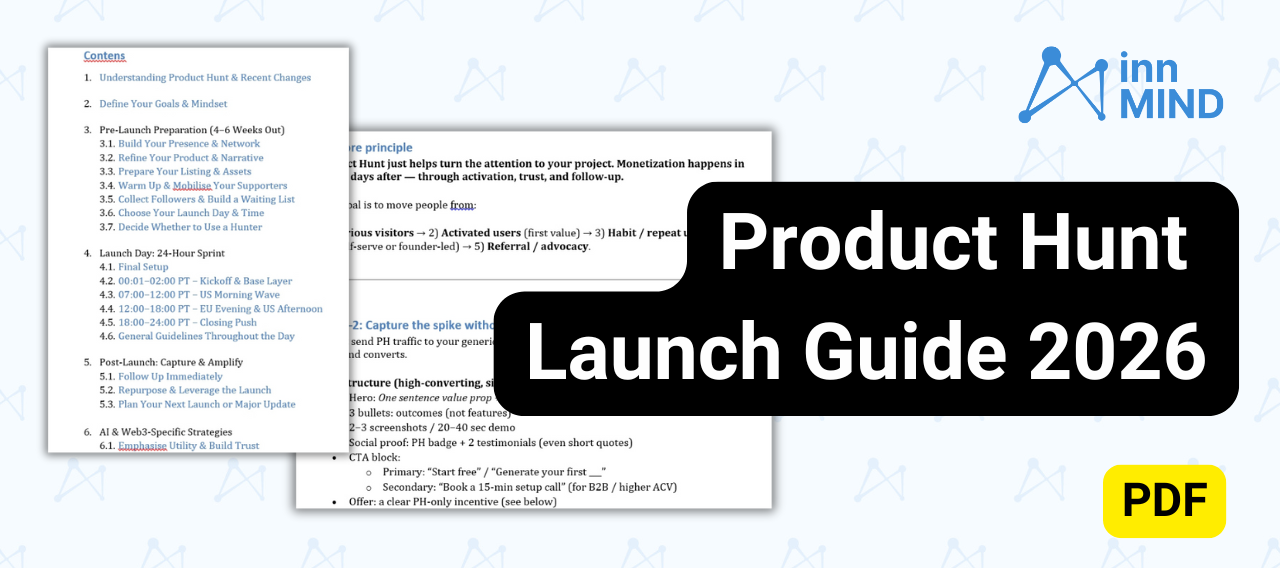
It includes:
- 4–6 week prep plan
- hour-by-hour launch day timeline
- post-launch capture + monetization playbook
- copy/paste checklists
If you use it once for a real launch, it pays for itself. Find it and download in our templates section.
FAQ for founders & builders:
- Do I need a hunter?
- Not necessarily. A strong hunter can help distribution, but assets + narrative + execution matter more.
- Is Product Hunt only for consumer apps?
- No. Dev tools, infra, B2B SaaS, and even niche products can win if your story is clear and your onboarding hits fast.
- What matters more: upvotes or comments?
- Quality engagement beats empty signals. Focus on real feedback and an experience that converts.
- What’s the biggest post-launch mistake?
- Not having a 30-day conversion & monetization plan. The spike is temporary; monetization is engineered.