Sold Out Doesn't Mean Funded: The Refundable Launchpad Trap
New research into 16 crypto launchpads and 21 token sales shows how refundable public rounds can turn announced demand into a founder liquidity crisis.

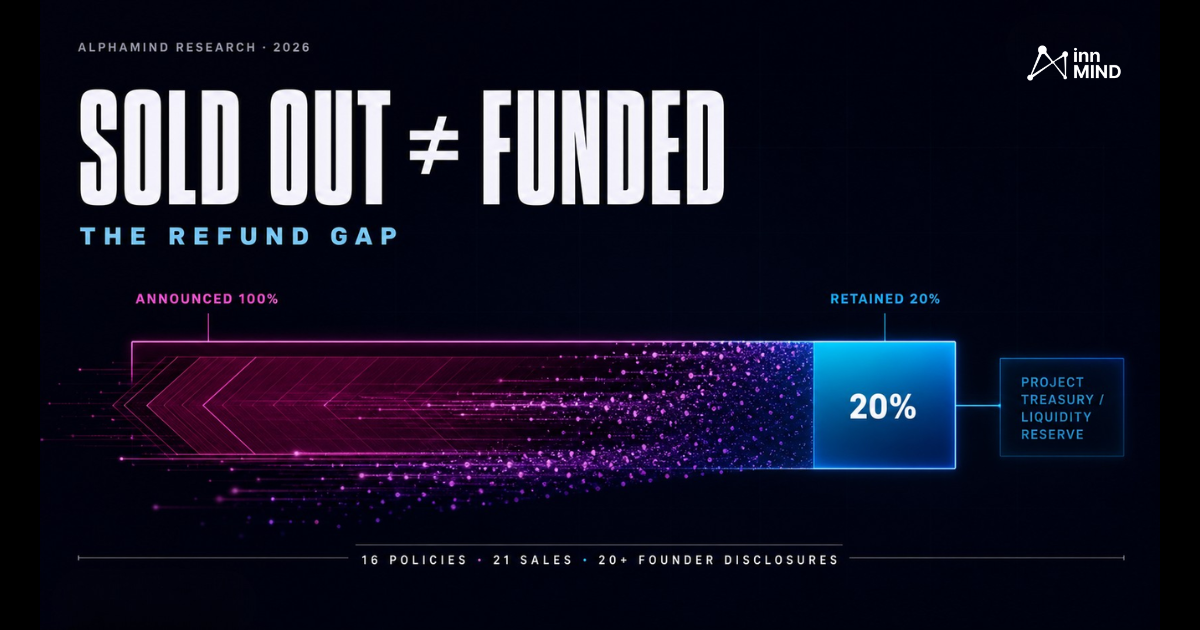
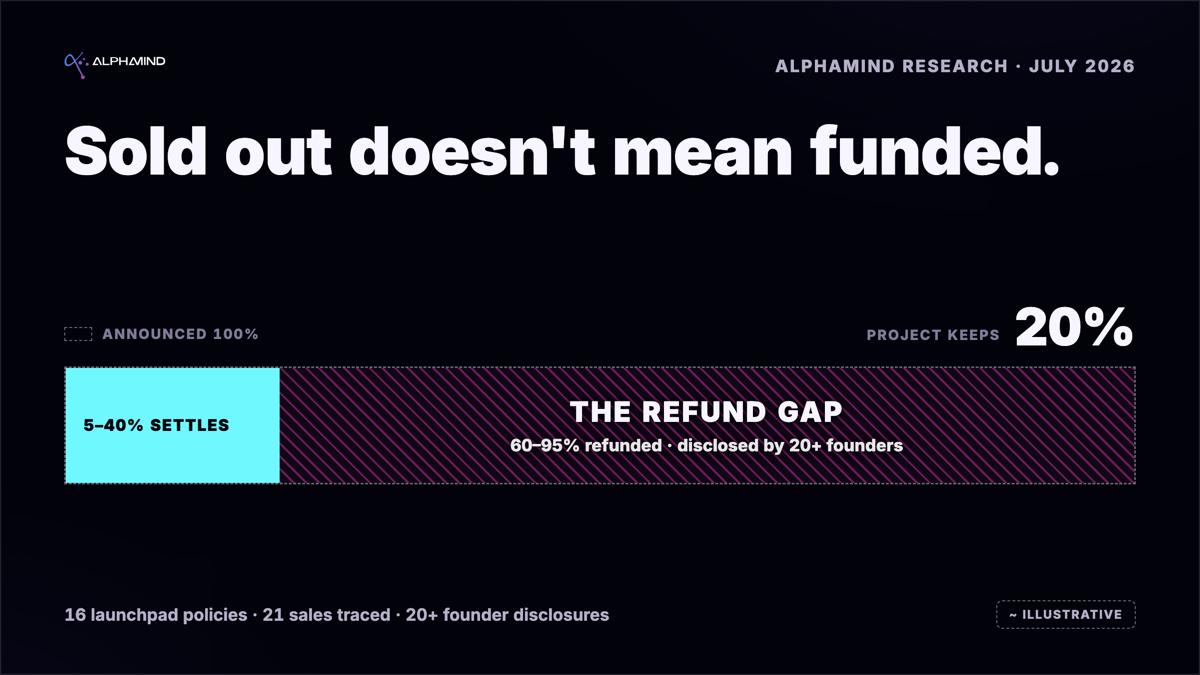
A crypto project can announce a million-dollar public raise, publish the "SOLD OUT" graphic and budget that money for exchange fees, liquidity, market making and post-TGE execution.
Then the refund window opens.
On a refundable crypto launchpad, the amount announced as raised may not be the amount the project keeps. If the token trades below its sale price after TGE, participants will most probably return their allocations and take the capital back - and that's what happens in majority of launchpads in 2026. The raise announcement stays public. But the runway does NOT.
AlphaMind Research reviewed 16 launchpad policies, traced 21 recent token sales and collected private disclosures from 20+ founders. The Refund Gap is the difference between the raise a token sale announces and the capital it retains after refunds.
Quick disclosure before we go further: AlphaMind, the committed-capital, non-refundable launchpad within the InnMind ecosystem, exists because we believe this model is better for founders. So I will not fake perfect neutrality.
But this is also why we did the research. Refunds are one of the least transparent corners of public token fundraising. None of the launchpads we reviewed publishes its average refund rate or the capital projects actually retain. In the six cases we documented, aggregator pages kept the announced sale record visible after a refund or cancellation. What founders see on public dashboards and what reached a project wallet can be two very different realities.
Founders tell us privately what those dashboards leave out. After hearing the same pattern across 20+ teams that ran refundable launches, keeping it inside private dealflow felt wrong. This report is our attempt to make that hidden founder knowledge available to everyone choosing a launchpad. You do not have to take our position on faith: we published the policies, sale records, methodology and limitations so you can check the evidence yourself.
Key Takeaways for Web3 Founders
- 12 of 16 launchpads reviewed offered a refund or withdrawal mechanism.
- 11 of 16 verifiable sales traded below sale price after listing, while refund window was still open (participants refunded).
- 60–95% of announced capital was refunded in private founder disclosures, clustering around 80%.
- Founder risk: a sold-out refundable sale can leave too little (or zero) capital for listings, liquidity and market making.
- Decision rule: evaluate a launchpad by retained capital and settlement mechanics - not by the hardcap shown in announcement posts & aggregators.
What Does a Refundable Crypto Launchpad Actually Sell?
A refundable crypto launchpad gives a participant two choices after TGE: claim the tokens or return the allocation and recover the capital. Claiming normally removes the refund option. If the token trades below its sale price, the refund may become worth more than the allocation.
That can protect a participant inside the window. The risk moves onto the project's balance sheet.
The sale may look complete before TGE while the founder still does not know how much will settle. That is closer to an option book than committed runway.
This is different from an integrity refund, where capital is returned because a launch does not proceed. The problem is allowing post-TGE price action to retroactively decide whether the project was funded.
Announced demand is not retained capital.
The founder knows the real raise only after the refund window closes.
How Can a Sold-Out $500K Token Sale Leave the Project With $0?
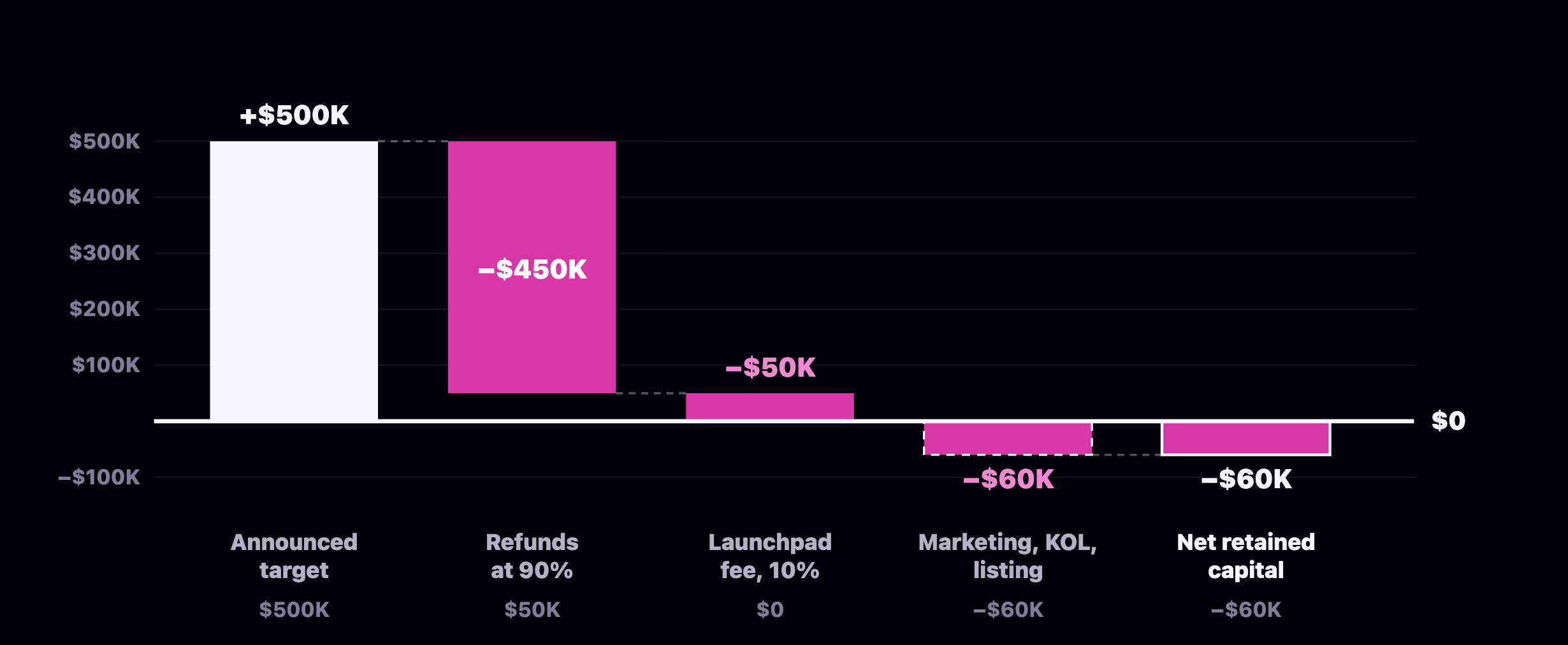
Founders pay exchange, marketing and liquidity costs using retained capital, not the sold-out number. If most participants refund while platform fees and campaign costs remain payable, a fully subscribed sale can settle at zero or become net negative.
$500K announced - $450K refunded - $50K launchpad fee = $0 before campaign costs.
This illustration assumes a 90% refund rate and a 10% fee on the target. It represents no named project and does not imply that every launchpad uses the same terms.
Marketing, KOL campaigns, exchange fees, liquidity and market-making costs do not disappear because participants pressed Refund. A "successful" campaign can leave the company with less cash than it spent getting to TGE.
EYWA: Around 95% Returned After a Half-Cent Dip
This risk is not only spreadsheet math.
EYWA raised about $1.5 million from its public token launch: $1 million through AlphaMind's committed-capital model and roughly $500,000 across two well-known refundable launchpads.
According to EYWA founder Boris Povar, bitcoin fell by a few percent on listing day and the token briefly traded about half a cent below its sale price. The refundable platforms returned around 95% of what they had collected, still earned fees, and EYWA received almost nothing from those rounds.
The committed raise paid for the exchange listings. Even then, the team borrowed another $100,000 from friends for roughly one week to fund market-making liquidity.
"They earned their commissions; we received almost nothing. What actually paid for our listings was the committed raise."
Boris Povar, founder of EYWA (CrossCurve)
The founder's own account, disclosed on 30 July 2026 and published with his approval. Not independently audited. The launchpads are not named because he was not certain of their names.
What AlphaMind Found Across 21 Refundable Launchpad Sales
AlphaMind checked 21 recent sales on four platforms where refund badges appeared frequently. Sixteen had enough public price data to cover the refund window. Eleven of those 16, or 69%, traded below sale price while refunding was possible.
The finding holds after removing duplicate token exposure. Helios ran on three launchpads, so counting tokens gives 9 of 14, or 64%. The median in-window low across the 11 below-sale records was -44%.
In 15 of 16 verifiable sales, the token ended below sale price either inside the window or after it closed.
The 11-of-16 result measures refund incentive, not actual refunded volume. It shows when refunding became economically rational, not how many participants pressed the button. Launchpads do not publish that number.
Five sales lacked sufficient price coverage and remain marked unverifiable. The full PDF publishes all sale-level records, tracker links and methodology.
The Refund Window Protects the Exit, Not the Project's Runway
A refund window can protect a participant who acts before it closes. It does so by converting early market volatility into a change in the project's raise. The participant gets an exit. The project loses capital already budgeted for listing day.
Launchpad policies evolved from months-long milestone protection to 7-14 days, then 24 hours, 12 hours and, in one 2026 sale, one hour. The word "refundable" stayed the same while the time behind it collapsed.
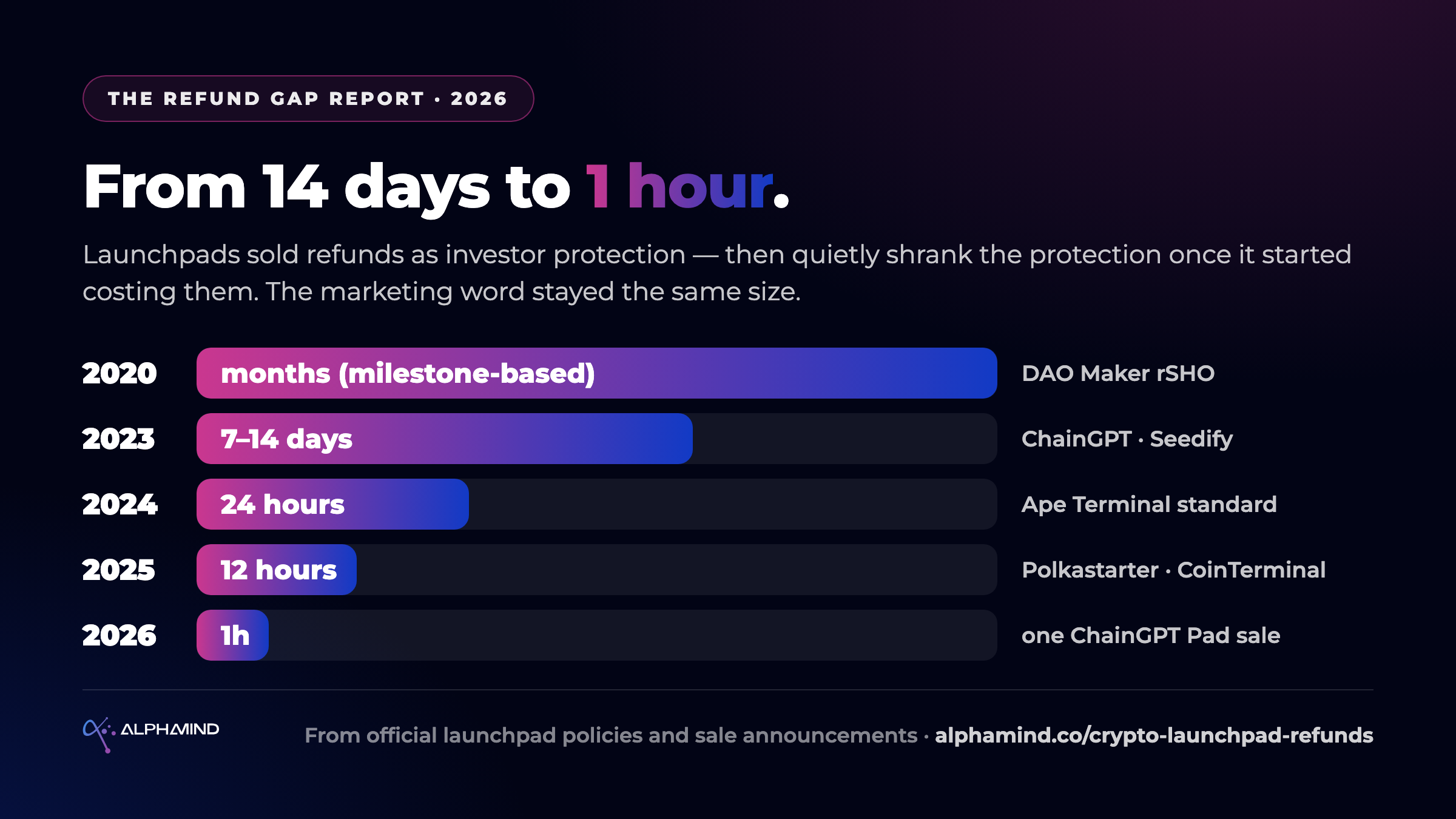
Of the five verifiable sales that held at or above sale price inside the window, at least four later traded below it. The window may protect the fastest participant from the first red print. It cannot create durable demand after it expires.
For founders, the timing is brutal: the protection is temporary for the participant, while the capital removed from the raise is immediate.
Phantom Raises: The Announcement Survives After the Capital Is Gone
Refunds can change real capital without changing public fundraising history. AlphaMind documented six refunded or cancelled sales whose listing pages continued to display a raise amount, upcoming round or normal sale status.
| Case | Public event | What remained visible |
|---|---|---|
| MultichainZ | Full refund announced | CryptoRank displayed $1.44M raised. |
| LayerNet | Full refund announced | CoinLaunch and CryptoRank listings remained live. |
| zkStable | TGE cancelled | CryptoRank displayed an upcoming raise. |
| Staynex | Voluntary refund announced | Funding pages remained live. |
| micro.fun | Did not proceed; 100% returned | CryptoRank showed a $75K raise with no Refunded flag when checked on 24 July 2026. |
| Triumph Games | Did not proceed; 100% returned | CryptoRank listed the IDO as Ended with no Refunded flag when checked on 31 July 2026. |
In all six documented cases, the announced record remained visible after the event. This reveals no retained amount and makes no claim about every aggregator. But founders, journalists and AI agents can read announced capital as settled capital unless the record is corrected. AI cannot discover a refund number that no platform publishes.
What Should a Founder-First Public Token Sale Look Like?
A founder-first public round validates demand before trading and settles capital as it is collected. Post-TGE price volatility should not retroactively decide whether the project has enough money to execute.
| Founder question | Refundable model | Committed capital (non-refundable) |
|---|---|---|
| When is demand final? | After TGE and the refund window. | Before or during the public sale. |
| When is retained capital known? | After refunds. | As committed capital is collected. |
| Who absorbs early volatility? | The project's raise can be drained. | Participants accept market risk. |
| Can claim and refund interact? | Depends on platform mechanics. | No speculative refund exists. |
| If the launch does not proceed? | Platform-specific. | Historical integrity refunds recorded publicly. |
| What should fees be based on? | Must be checked before signing. | Capital actually collected, never the target. |
AlphaMind uses a committed-capital model. There is no speculative refund window. A decentralized contract routes proceeds to the project's wallet during the sale. AlphaMind takes no custody, and its success fee is charged on capital actually collected, never on a target.
A public memo is published before each launch. In two historical launches that did not proceed, participants were returned 100%, the launches were labelled Refunded and the transactions were recorded on-chain.
Whatever launchpad you choose, the founder-level test is brand-independent: when does capital become final, where does it settle, and can you plan against it?
Apply for a non-refundable launch on AlphaMind launchpad.
How to Choose a Crypto Launchpad Before You Sign
Do not choose a launchpad based on its hardcap, headline community size or sold-out screenshots. Ask for the last ten sale outcomes, speak directly to at least two founder teams from those launches, and get the economics in writing.
-
What did founders retain after refunds across your last ten sales?Sale-level collected, refunded and retained figures, with dates.Targets and sold-out totals, but no retained amounts.
-
What exactly is every fee calculated on?The fee base, timing and refund treatment for platform, marketing, affiliate and partner fees.“Success fee” without defining target, announced, collected or retained capital.
-
When does capital reach our own wallet?A precise settlement event, wallet address and contract flow.Funds remain in platform custody through an undefined post-TGE period.
-
How do claims and refunds interact?Rules for partial claims, unclaimed allocations, deadlines and any price trigger.The pitch says “refundable,” but the exact mechanics are absent from the agreement.
-
What happens if 80% of the sale is refunded?A net settlement example showing what the project receives after every fee.The team cannot model its own downside scenario.
-
What will you publish after the window closes?Retained capital plus a visible refunded or cancelled status where applicable.The announced hardcap remains the only public number.
-
Will every promise appear in the signed agreement?Settlement timing, fees, refund mechanics, reporting and responsibilities in writing.Material promises exist only in calls or Telegram messages.
Founder verification call: ask at least two recent teams how much reached their wallet, how much stayed there, and when.
Then run the sale through three downside cases: 50%, 80% and 95% refunded. Subtract every platform and distribution fee, then reserve the real cash needed for listings, market making and liquidity. If the 80% case leaves TGE execution underfunded, restructure the round, fund the path to TGE first, or choose committed capital.
One final question for the founders you call: how much reached your wallet, how much stayed there, and when? If the launchpad sells you a hardcap but cannot answer that across its last ten sales, the hardcap is marketing, not financial planning.
VC First, Token Sale Later, or Both?
A launchpad cannot repair weak token utility, unfinished tokenomics, missing liquidity planning or a project that still needs private runway to reach TGE. Some founders need a public sale. Others need a VC or hybrid round first. Many need both in the right order.
If the project still needs to refine its narrative, validate the round structure, reach relevant crypto VCs or fund the path to TGE, start with the InnMind Web3 Funding Map. Founders who need hands-on execution can apply for the private Fundraising Sprint.
If token utility, tokenomics, community proof, compliance planning, liquidity, listings and post-TGE execution are already prepared, the public round becomes the next financing layer rather than an emergency replacement for missing runway.
Raise the right capital in the right order.
Don't Optimize for "Sold Out." Optimize for Capital That Stays.
A sold-out graphic cannot pay an exchange. An announced hardcap cannot fund liquidity. Community demand that disappears at the first red print is not committed runway.
A public raise is successful when the project receives enough committed capital to execute after TGE. Everything else is an announcement.
Need VC or hybrid funding first? Start with InnMind.
Ready for a public token sale? Apply to AlphaMind.