How to Save Your Startup $100K+ in 2026: The Founder's Guide to Startup Credits & Perks
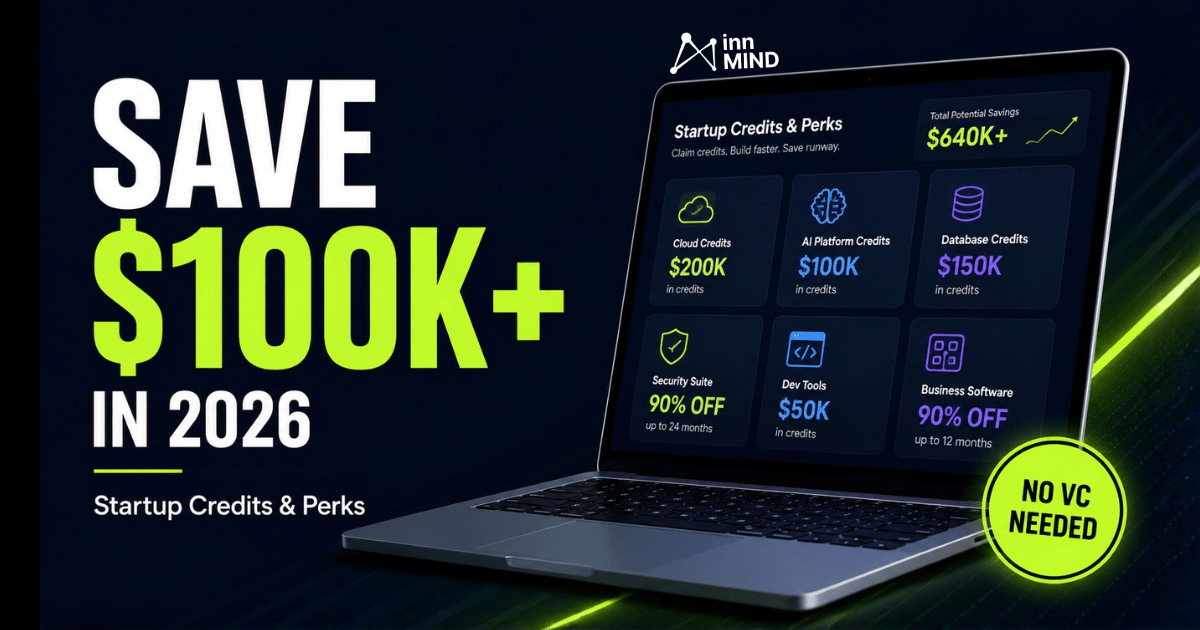
Founders burn runway paying full price for software that is free for startups. Here's the 2026 playbook for claiming $100K+ in credits & perks, the traps to avoid, & the fastest place to start.

Every week I meet a founder paying full price for AWS, Notion or some AI tool, while the exact same product is sitting there free for startups. They never claimed it. Nobody told them it existed.
It is rarely "just $20 a month." It is $20 here, $99 there, a $500 annual plan you forgot to cancel, a cloud bill that quietly doubled. Those tiny payments stack up & quietly kill your runway. In 2026 the gap between founders who claim startup credits & founders who pay sticker price is measured in months of extra runway.
The short answer
Most early-stage startups can claim well over $100,000 in cloud credits & software discounts in their first year, without raising a round & without paying a cent for the access. The catch is that the offers are scattered across dozens of provider pages, each with its own eligibility rules, & most founders never find them. This guide shows what is actually claimable in 2026, what to skip, & the fastest way to do it. If you want to skip the reading, the shortcut is a curated startup perks database that puts the real offers in one place.
Credits vs discounts: know the difference
Two different things get lumped together as "perks," & they behave differently:
- Credits are real spending money on a service, like "$100,000 in AWS credits." They usually expire, often in 1 to 2 years, so you claim them when you can actually use them.
- Discounts are a percentage off the normal price, like "6 months of Notion free" or "90% off your first year." These often renew at a reduced rate, so they keep saving you money longer.
Rule of thumb: chase credits for the big infrastructure line items, & chase discounts for the tools you will use for years.
What is actually claimable in 2026
Here is the honest picture. The "paper" column is the maximum a provider advertises. The "realistic" column is what a bootstrapped pre-seed team with no VC backing can usually get, because the biggest numbers are gated behind accelerators or investor referrals.
Startup perks: advertised value vs. realistic bootstrapped value
A practical comparison of popular startup credits, discounts and partner programs founders can use to reduce early operating costs.
| Program | Advertised value | Realistic for bootstrapped startups | Type |
|---|---|---|---|
| Google for Startups Cloud | $200K ($350K AI-first) | ~$100K year 1, Start tier, no VC needed | Credits |
| Microsoft for Startups | $150K Azure + OpenAI models | $1K instant, then scale up | Credits |
| AWS Activate | $100K ($300K GenAI tier) | $1K to $5K self-serve, more via a startup bank | Credits |
| NVIDIA Inception | $100K+ via partners | Free to join, GPU discounts + partner credits | Credits + discounts |
| Cloudflare for Startups | $250K enterprise credits | Startup program, eligibility-based | Credits |
| Notion, Zendesk, HubSpot & more | 6 to 12 months free, up to 90% off | Mostly self-serve, claim today | Discounts |
Tip: advertised values usually represent the maximum possible benefit. The practical value depends on startup stage, eligibility, verification and partner access.
On paper the full stack clears $800K. In reality, a bootstrapped team that claims the self-serve tiers still walks away with $100K+ in the first year, plus software discounts worth thousands more. That is the number worth chasing, & it is real.
Which perk is actually for you (and whether you'll qualify)
The headline number is the easy part. What nobody spells out is what each program is genuinely good for, & the fine print that decides whether you actually get in. Here is the short version, from working with founders who claim these every week.
- Microsoft for Startups: the friendliest place to start. Use it to run your backend, app hosting & databases on Azure, & it bundles in OpenAI model access (GPT models, paid from your Azure credits), GitHub Enterprise & Microsoft 365. Why it is easy: no funding, no pitch deck, $1,000 instant & up to $5,000 after a quick verification. The catch: you must be a new Azure customer, so if you already run on Azure you may miss the entry tier.
- Google Cloud: for real production at scale. Best if you run Kubernetes, managed Postgres, BigQuery for analytics, or train & serve models on Vertex AI. Bootstrapped teams get the Start tier (around $100K, no VC needed); the $200K to $350K headline is for AI-first or funded teams. Web3 teams get a separate track with ecosystem grants from Polygon, Solana & NEAR. One catch: the Start tier wants you to have no prior Google Cloud credits beyond the free trial.
- AWS: the default if your stack is already AWS-native. EC2 & Lambda for compute, S3 for storage, managed databases, the usual. Plan for the real tier, not the poster: the $100K everyone quotes needs an accelerator or VC referral. Bootstrapped, you get the $1K to $5K self-serve tier (valid about 2 years), or more by opening a startup bank account that bundles AWS in.
- NVIDIA Inception: the one that matters if you train models. GPU compute is the single most expensive line in AI, & this covers it through partner credits, plus Deep Learning Institute training & investor intros. Free to join, no equity. Two hard things to know: crypto & blockchain companies are excluded, & the top reasons people get rejected are a personal gmail address & a thin website. Apply with a company domain & a real site.
- ElevenLabs: for putting AI voice inside a product. Voice agents, dubbing & localization, accessibility tools, or AI-avatar apps for social & marketing. The nuance worth knowing before you apply: the grant is for a product you are taking to market, so an AI-avatar app qualifies, but "I make social videos" on its own usually will not. Agencies, consultancies & enterprises are not eligible, & you need fewer than 25 people.
- Cloudflare: put your whole app behind it. DDoS protection, a global CDN, edge compute with Workers, & R2 object storage with zero egress fees, which alone can undercut an S3 bill. Credits are tiered by stage: about $5K bootstrapped, $25K angel-backed, $100K seed, $250K Series A & up. You need a real software product that uses Cloudflare, a registered entity, & under 5 years in. Accelerator or Workers Launchpad alumni get a bump.
- Notion: the five-minute win, with a catch worth knowing. Your team wiki, docs & project tracking, now with AI built in. Here is the part most founders miss: apply to Notion directly & you get 3 months free, but apply through a partner & you get 6 months of the Business plan plus AI. InnMind is a partner, so claiming it through the InnMind link doubles your free window. One rule: it only works on a brand-new Notion account that has never been on a paid plan, with a company email.
The startup credits trap nobody warns you about
Credits are not free money. They are free if you would have spent that money anyway. The mistake I see most is founders collecting credits like trophies, then drowning in setup work: ten dashboards, scattered logins, a tool nobody on the team maintains after week one, & a cloud account configured to start billing the moment the credits run out.
So claim with discipline. Start with the cost that is hurting your runway right now, claim that one, & move on. A perk that mainly creates permission sprawl & data cleanup is a cost, not a saving. We broke down the full version of this in our founder playbook on cutting burn rate.
The 2026 playbook: how to claim smart
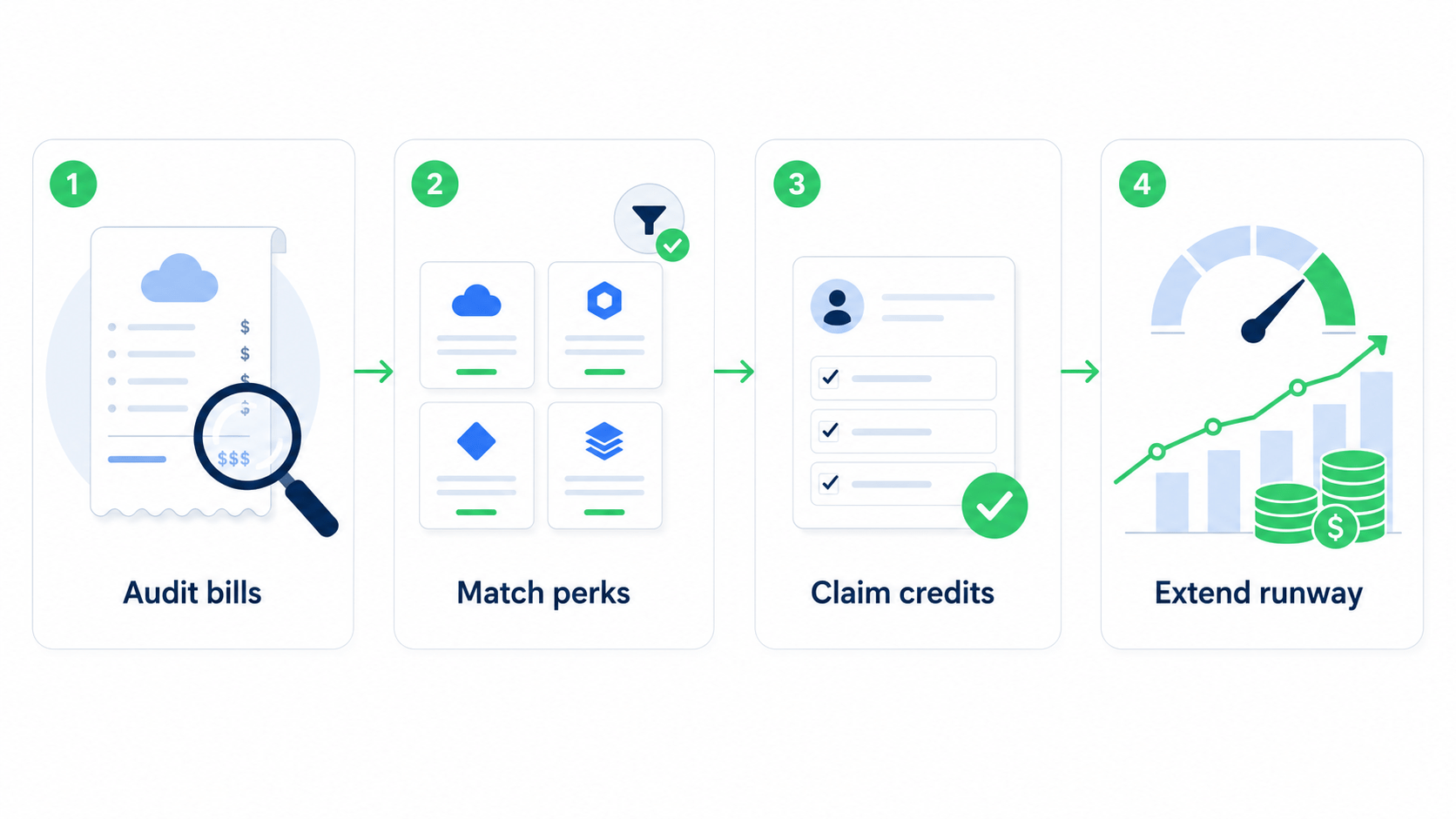
- Start with your biggest bill. If cloud is killing you, claim Google Cloud, Microsoft Azure or AWS first. If you train models, NVIDIA Inception covers the most expensive line item in AI: GPU compute.
- Use the startup-bank shortcut. Opening a startup banking account (Mercury, Brex, Ramp) or incorporating through Stripe Atlas unlocks 50 to 100 partner perks in one move, including AWS, OpenAI, GitHub & more bundled together. It is the highest-leverage hour a founder can spend in month one.
- Grab the evergreen discounts. Tools you will use for years, like Notion or Cloudflare, are mostly self-serve. Claim them once, save for years.
- Do not forget non-dilutive money. Credits extend runway, but grants add actual capital. If you are in Web3, our list of active blockchain grant programs is a good second move.
The shortcut: one curated place instead of forty tabs
The reason most founders never claim this stuff is simple: hunting it down across forty provider pages is its own part-time job, & the eligibility rules change constantly. That is exactly why we built the InnMind Startup Perks Database: a curated catalog of cloud credits, AI tools, fundraising software & Web3 infrastructure offers, each with a clear "what you get & how to claim it" page. It is built for Web3, AI & tech founders specifically, so you are not wading through perks for e-commerce stores you will never run.
Browsing is free. You register to unlock the free offers, & a handful of higher-value perks sit behind InnMind Premium.
What changed in 2026
- AI compute is the new battleground. GPU credits through NVIDIA Inception & AI-first cloud tiers (Google now goes up to $350K for AI-first teams) are the most valuable perks of the year. If you build with AI, this is where the real money is.
- The bundle beat the hunt. Startup banks now aggregate dozens of perks, so one account replaces a week of applications.
- Discounts got longer. Voice, analytics & productivity tools moved from "30 days free" to 6 & 12 month grants to win startups early. ElevenLabs, for example, now gives accepted startups a full year of AI voice.
For the tools themselves, our running list of the best AI tools for startups in 2026 pairs well with this guide.
Building on Claude, GPT or Gemini? Our guide to free AI credits for startups in 2026 shows which programs still pay out & which ones take bootstrapped teams.
Frequently asked questions
What are startup credits?
Startup credits are free spending money a provider gives eligible early-stage companies to use on its product, for example $100,000 in AWS cloud credits or $200,000 in Google Cloud credits. They usually expire within 1 to 2 years.
How much can a startup actually save with credits & perks?
A bootstrapped pre-seed startup can realistically claim over $100,000 in cloud credits in its first year, plus software discounts worth thousands more. Funded startups with accelerator or VC backing can access far higher tiers, up to $300K to $350K from a single cloud provider.
Do I need funding or a VC to get startup credits?
No. The largest tiers are gated behind accelerators or investors, but most programs have a self-serve tier open to any incorporated startup. Microsoft, AWS & Notion all offer instant or near-instant entry-level credits with no funding required.
What is the fastest way to claim startup perks?
Two moves: open a startup banking account (Mercury, Brex or Ramp) to unlock 50 to 100 bundled perks at once, & use a curated startup perks database so you are not hunting across dozens of provider pages.
Are startup credits worth the setup time?
Only the ones you will use. Claim the perk that reduces a bill you already pay. Skip perks that mainly create setup work, extra logins or a tool nobody maintains. A credit you never use is a distraction, not a saving.
Can I get the ElevenLabs grant for AI avatars or social content?
ElevenLabs voices power AI-avatar & social content, & its grant supports creator-style use cases. The nuance: the grant is for a product you are taking to market, so an AI-avatar app or tool qualifies, while one-off personal content creation usually does not. Agencies, consultancies & enterprises are not eligible, & the program is for companies with fewer than 25 people.
What is InnMind?
InnMind is a fundraising & growth platform for Web3, AI & tech founders. It runs a curated startup perks database, investor databases & fundraising tools, helping founders cut costs & raise faster. You can browse the perks free & register to unlock them.
Stop paying full price. Browse the InnMind Startup Perks Database, claim the first perk that cuts a bill you already pay, & put those months of runway back where they belong: into building.