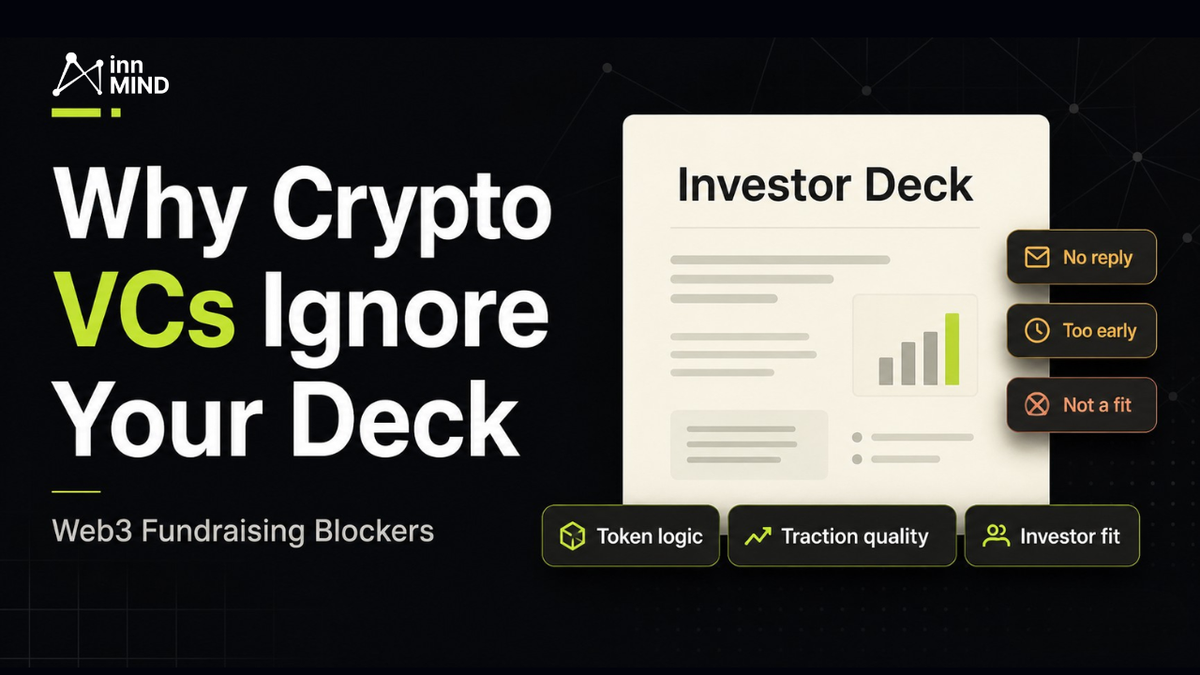
Web3 Fundraising Blockers: Why Crypto VCs Ignore Your Deck
Crypto VCs still invest, but weak Web3 decks get ignored fast. Diagnose the fundraising blockers behind investor silence: token logic, traction quality, round structure, compliance, and investor fit.

You sent the deck to dozens of VCs..
A few investors opened it. One replied "interesting, let's stay in touch." Two asked for more materials and then went quiet. Most said nothing at all.
That silence hurts, but it is rarely random.
In Web3 fundraising, silence usually means your investor package was too easy to discount. Not because you are a bad founder. Not because crypto VC fundraising is impossible right now. It usually means the deck triggered one of the doubts crypto investors no longer bother to write back about: unclear token logic, weak proof, the wrong round structure, poor investor fit, synthetic traction, or a category that feels unfundable in the current cycle.
This is the part founders miss most often. They treat silence as a distribution problem: "We need to email more crypto investors." Sometimes that is the right answer. But sending the same deck to another fifty funds only helps if the blocker was reach. If the blocker is sitting inside the pitch, more outreach just burns more of your investor list.
This article is a diagnostic. Not another generic guide on making your pitch deck prettier.
Use it to figure out what crypto VCs are probably thinking when they ignore your deck — and what to fix before you keep sending it.
The market changed: crypto VCs are filtering harder in 2026
The lazy explanation is "Web3 fundraising is dead." That is not accurate.
Capital still moves into crypto and blockchain companies. Galaxy's Q4 2025 crypto venture report reported $8.5 billion invested across 425 crypto startup deals in Q4 2025, with more than $20 billion across 1,660 deals for the full year. Galaxy also noted that stablecoins, AI, and blockchain infrastructure continued to draw deals and dollars, while pre-seed deal counts stayed healthy.
But the same report explains why founders feel the market is harder: capital is concentrated. In Q4 2025, eleven deals above $100 million accounted for 85% of the quarter's crypto VC capital, according to Galaxy. The headline number can look active while early-stage founders still get filtered brutally.
The April 2026 picture looked tighter still. Cointelegraph, citing CryptoRank data via TradingView News, reported that crypto VC funding dropped to $659 million across 63 rounds in April 2026, down from $2.6 billion across 84 rounds in March. The same report flagged DeFi as the most active April category, followed by blockchain services and AI-linked crypto projects.
The practical takeaway: the market is not closed, but the first scan is far less forgiving. Crypto VCs are not looking for another deck that says "community," "ecosystem," "TGE," and "mass adoption." They are looking for proof they can underwrite quickly.
In 2026, Web3 startup fundraising is less about selling crypto upside and more about surviving investor distrust.
2026 fundraising reality check
Capital is still there. Easy checks are not.
The Web3 fundraising market is not closed, but it is more selective. Recent data points show a market where capital concentrates around fewer, higher-conviction deals — while weaker early-stage decks get filtered faster.
invested into crypto startups in Q4 2025 across 425 deals
invested across 1,660 crypto startup deals during full-year 2025
of Q4 2025 capital came from 11 deals above $100M
raised across 63 crypto VC rounds in April 2026, down from $2.6B in March
Founder takeaway: investors are not ignoring Web3. They are ignoring unclear Web3 fundraising packages — especially decks with weak proof, vague token logic, synthetic traction, or mismatched round structure.
Sources: Galaxy Q4 2025 Crypto Venture Report; Cointelegraph / CryptoRank via TradingView, April 2026.
How crypto investors scan a Web3 deck
A Web3 pitch deck is not just a story document. It is an early diligence object.
A crypto investor is usually scanning for five things:
- What is this, exactly? Token protocol, hybrid company, or equity-only crypto infrastructure?
- Why now? Why does this category deserve capital in this cycle?
- Is the proof real? Revenue, retained usage, paid demand, on-chain activity, integrations, fee generation — or just campaign metrics?
- What is the investor actually buying? Equity upside, token upside, token warrant exposure, SAFT rights, or a confusing mix?
- Is this worth a call? Can the fund plausibly get conviction, help the company, and fit the round?
Founders write decks to explain. Investors read decks to disqualify.
Investor first scan
The five questions your Web3 deck must survive
A crypto VC is not reading your deck like a founder reads it. They are moving through a fast decision path: category, timing, proof, ownership, and whether the next call is worth the time.
What is this?
Token protocol, hybrid company, or equity-only crypto infrastructure?
Why now?
Why does this category deserve capital in the current cycle?
Is the proof real?
Revenue, retained usage, fees, integrations, or on-chain activity — not just campaign numbers.
What is the investor buying?
Equity upside, token upside, SAFE, SAFT, token warrant, or a clear hybrid structure?
Is this worth a call?
Can the fund build conviction, help the company, and fit the round?
Founder takeaway: if your first three slides do not answer questions 1–3, investors may never reach your tokenomics, roadmap, or team slide.
That is why beautiful slides still get ignored. If the first pass creates more questions than confidence, the deck gets parked.
Before you rewrite anything, classify your company correctly.
Token/protocol projects
DeFi protocols, DePIN networks, L1/L2 infrastructure, decentralized AI networks, liquidity networks, and projects where the token is central to security, coordination, incentives, access, or value accrual.
For these companies, investors will dig into token utility, emissions, unlocks, vesting, FDV/float, TGE readiness, liquidity, market-maker logic, and post-launch demand.
Hybrid company + token projects
The trickiest category. The company may have SaaS revenue, marketplace fees, API usage, or B2B contracts, plus a token or network coming later.
The investor question becomes: does upside accrue to the company, the token, or both? If the company can win while token investors lose, the round structure has to be unambiguous.
Equity-only crypto companies
Crypto SaaS, compliance, security, custody, analytics, wallets, payments infrastructure, devtools, institutional rails, data products with no token.
These companies should not sound like token projects. They should be underwritten like B2B infrastructure, fintech, security, data, or compliance: buyer, budget, sales cycle, revenue quality, retention, integrations, urgency.
Founder self-check
Which Web3 fundraising story are you actually pitching?
Before you fix the deck, classify the company. Crypto investors will scrutinize different risks depending on whether you are raising for a token protocol, a hybrid company with token exposure, or an equity-only crypto business.
Token / protocol project
Token-first underwriting- You are this if
- The token is central to the network, protocol, incentives, liquidity, governance, staking, access, or security model.
- Investors scrutinize
- Token utility, value accrual, emissions, vesting, unlock schedule, FDV vs float, TGE timing, liquidity, market-maker logic, and post-TGE demand.
- Deck mistake
- Treating TGE as a roadmap milestone without explaining who buys, who sells, and why the token should hold value after launch.
Hybrid company + token
Company + token alignment- You are this if
- The company has a real business model — SaaS, marketplace, API, payments, data, or infrastructure — but may also launch a token or network later.
- Investors scrutinize
- Whether value accrues to equity, token, or both; whether investors get the right exposure; SAFE + token warrant logic; token timing; and what happens if no token launches.
- Deck mistake
- Letting the business look investable while the token looks like a side bet with unclear upside for token investors.
Equity-only crypto company
Business-first underwriting- You are this if
- You sell software, infrastructure, compliance, custody, analytics, security, APIs, wallets, payments rails, or institutional tooling without a token.
- Investors scrutinize
- Buyer urgency, budget, revenue quality, retention, sales cycle, integrations, margins, compliance exposure, and why customers keep paying in weak markets.
- Deck mistake
- Sounding like a token project when investors should be evaluating you as B2B infrastructure, fintech, security, data, or compliance software.
Founder takeaway: the wrong category framing can make a good company look unfundable. Do not force token logic onto an equity-only business — and do not hide token risk inside a company story.
Now let's get into the blockers.
1. Token without a job
Founder symptom: "Our token will power the ecosystem."
That line used to pass as Web3 ambition. Now it usually reads as added risk.
A token needs a job. Not a slogan. Not a future community benefit. A real job inside the system: coordination, security, access, payment, staking, liquidity, governance with teeth, or value capture that cannot be done more cleanly with stablecoins or normal pricing.
Investors notice when the product would work fine without the token.
Placeholder's 2025 essay on L1 token value accrual argues that stablecoins increasingly compete with native tokens for on-chain payments, collateral, and financial accounting. The implication for founders is uncomfortable: if users can pay in stablecoins and ignore your token, you need to explain why the token still captures value.
What investors think: "The token adds regulatory, liquidity, listing, and market structure complexity. Why do I need it?"
Fix before outreach: Add a token role slide that answers:
- What must the token actually do?
- Who needs it?
- What happens if users pay in stablecoins?
- What creates recurring demand?
- What value goes to equity holders versus token holders?
If the token is not needed yet, say so. A clean equity-first story can be stronger than a vague token story.
2. Wrong instrument
Founder symptom: "We are flexible — SAFE, SAFT, token round, whatever investors prefer."
Flexibility sounds founder-friendly. To investors, it can sound like you do not know what you are selling.
For Web3 fundraising, the instrument has to match the company type:
- Equity-only crypto company: priced equity round, SAFE, or convertible note.
- Token/protocol project: SAFT or token round may fit when token design is mature enough.
- Hybrid company: SAFE + token warrant or side letter may fit when investors need company exposure plus token optionality.
This is not legal advice. It is fundraising clarity.
Y Combinator's SAFE documentation explains the SAFE as a widely used early-stage instrument for future equity. In Web3, the token side adds another layer. Mintz's blockchain investor explainer outlines the common forms — equity, SAFEs, SAFTs, token warrants — and notes that token warrants are often issued alongside another security such as stock or a convertible equity instrument.
What investors think: "I cannot tell whether I own company upside, token upside, or both."
Fix before outreach: Put the round structure in plain English:
- Amount raising
- Instrument
- Valuation or cap, if relevant
- Token rights, if any
- Token status and expected timing
- Use of funds
- Milestones this round should finance
If you need a starting point for hybrid docs, InnMind has a SAFE + token warrant agreement template you can review with counsel.
3. Business-token value split
Founder symptom: "The business can grow even if the token comes later."
That may be true. It may also scare token investors.
Hybrid Web3 companies often hide a value split they have not actually resolved. The company captures revenue. The token captures vibes. Founders see optionality. Investors see misalignment.
If investors get token exposure, they need to understand why token holders share the upside. If investors get equity, they need to understand whether a future token quietly drains value out of the company.
What investors think: "The product may win, but the asset I am buying may not."
Fix before outreach: Add a value-flow slide:
- Who pays?
- What do they pay with?
- Where do fees go?
- What accrues to the company?
- What accrues to the token?
- What happens if no token launches?
- What investor rights exist in each case?
This is one of the most common reasons a "promising" Web3 deck stalls after initial interest.
4. Premature TGE
Founder symptom: "TGE in Q3 is one of our next milestones."
Founders present TGE as progress. Investors often read it as supply hitting the market.
A token generation event opens a long list of questions: float, FDV, initial market cap, unlock schedule, liquidity depth, market maker setup, exchange route, emissions, investor vesting, real user demand, and sell pressure.
The token market has gotten less forgiving of weak launches. Delphi Digital's 2025 digital asset secondary markets report describes how secondary pricing is shaped by token unlocks, public market comps, and valuation overhangs, and notes that 64% of H1 2025 deals priced below prior rounds. See The Evolution of Digital Asset Secondary Markets 2025.
What investors think: "Who buys after launch? Who sells? Who absorbs the unlocks?"
Fix before outreach: Do not lead with a hard TGE date unless you can explain:
- Why the network is actually ready
- Initial float versus FDV
- Investor and team vesting
- Emissions schedule
- Liquidity plan
- Post-TGE usage
- Why the token does not become exit liquidity for earlier holders
If the answer is not ready, make TGE a conditional milestone, not the headline.
5. Incentivized traction mistaken for adoption
Founder symptom: "We have 100K users and 80K community members."
In Web3, user numbers are cheap to inflate. Quests, points, airdrops, KOL campaigns, Telegram pushes, testnet incentives — all of it can produce activity that vanishes the moment rewards stop.
That does not mean campaign-driven traction is worthless. It means you have to separate it from real adoption.
Binance Research's 2025 airdrop report discusses how engagement-based airdrops often require tasks that directly increase project activity or social presence. Formo's airdrop analytics guide argues that airdrop campaigns need clear objectives and measurable outcomes, not vanity metrics.
What investors think: "These could be airdrop hunters, bots, quest users, or mercenary wallets."
Fix before outreach: Split your traction slide into:
- Incentivized users
- Non-incentivized users
- Retained wallets after incentives stopped
- Repeat actions
- Paid usage or deposits
- Revenue or fees
- Cohort behavior
- High-quality users worth interviewing
A small cohort of retained users can be more credible than a giant campaign number with no retention.
6. TVL without quality
Founder symptom: "We already have $5M TVL."
TVL is not useless. But TVL alone does not prove demand.
Investors want to know where the capital came from, how concentrated it is, how long it stays, what rewards it earns, what risk it takes, and what fees it generates.
The Algorand Foundation's 2025 research challenged TVL as a standalone metric, finding that TVL can be inflated, double-counted, and was not predictive of token performance across a study of more than 300 cryptocurrencies.
What investors think: "The TVL may be rented."
Fix before outreach: Show TVL quality, not just TVL size:
- Organic vs incentivized TVL
- Depositor concentration
- Average duration
- Churn
- Yield source
- Fee take
- Risk controls
- What happens when rewards stop
For DeFi, RWA, lending, vaults, and yield products, this slide can matter more than the roadmap.
7. Compliance hand-waving
Founder symptom: "We are non-custodial, so we should be fine."
That may be true. It may also be incomplete.
If you operate in payments, stablecoins, RWA, custody, credit, cards, on/off-ramp, tokenized assets, or asset management, investors expect legal and compliance thinking early.
The stablecoin and tokenization market is becoming more institutionally relevant, and more closely scrutinized. The Federal Reserve wrote in April 2026 that stablecoin market capitalization reached $317 billion as of April 6, 2026, up more than 50% since early 2025, while flagging financial stability considerations around intermediation, vertical integration, and retail adoption.
Cooley's February 2026 analysis of the SEC staff statement on tokenized securities makes the key point cleanly: tokenized securities remain securities, and tokenization does not remove existing registration or exemption requirements.
What investors think: "This may become a legal execution problem before it becomes a product problem."
Fix before outreach: Add a compliance path slide where relevant:
- Jurisdiction
- Entity setup
- Licensing path
- Regulated partners
- KYC/KYB model
- AML/sanctions controls
- Custody model
- Issuer/reserve setup, if relevant
- Redemption path, if relevant
- Legal opinion still missing
Do not overstate certainty. Investors prefer "here is what we know, here is what counsel is reviewing" over hand-waving.
8. Fake mass adoption / no GTM wedge
Founder symptom: "We are onboarding the next billion users."
Investors have heard this for years.
The problem is not ambition. The problem is mismatch. Many Web3 decks claim mainstream adoption, then describe crypto-native acquisition: quests, KOLs, Telegram, airdrops, points, CT threads, and exchange listing plans.
That is not mainstream GTM. That is crypto distribution.
What investors think: "Where do the first real users come from, and why do they stay?"
Fix before outreach: Replace "mass adoption" with a wedge:
- First buyer or user segment
- Specific pain
- Current alternative
- Acquisition channel
- Activation moment
- Retention loop
- Monetization path
- Why this can expand later
If your wedge is crypto-native, own that. Do not call it Web2 adoption.
9. Weak investor pipeline
Founder symptom: "We spoke with 30 crypto investors."
Maybe you did. Or maybe you spoke with syndicates, DAO pools, Telegram investor groups, launchpads, advisors, ecosystem scouts, and service providers wearing VC branding.
Pipeline quality matters.
A real crypto VC investor list is not a list of logos. It should be filtered by stage, check size, sector thesis, geography, token appetite, lead/follow behavior, and recent deal activity.
What investors think: "If this deal has been everywhere and no serious fund moved, what did the others see?"
Fix before outreach: Segment your pipeline:
- Lead-capable funds
- Follow-on funds
- Strategic angels
- Ecosystem funds
- Exchanges and market makers, if relevant
- Syndicates
- Advisors/service providers
- Launchpads
- Non-check-writers
Then rebuild the first 50 targets around fit, not volume. If you need a starting point, InnMind has a Web3 angel investor database and startup members can use InnMind's investor discovery workflows to narrow outreach by relevance.
10. Advisory disguised as capital
Founder symptom: "They said they can help us raise if we join their program or pay an advisory fee."
This is common in crypto.
Some groups are investors. Some are accelerators. Some are launchpads. Some are service providers. Some are useful. Some are expensive detours.
The fundraising problem starts when founders treat all of them as capital.
What investors think: "The founder may not know how to qualify capital sources."
Fix before outreach: Ask every "investor":
- Do you invest from a committed fund?
- What is your typical check size?
- Do you lead rounds or follow?
- What deals did you invest in during the last 12 months?
- Do you charge fees?
- What is your decision process?
- Who signs the check?
If they sell services, call them service providers. That does not make them bad. It makes them different.
11. Crypto adjacency tax
Founder symptom: "We are Web3 infrastructure for the future of on-chain businesses."
This may hide a strong company.
If you are equity-only crypto SaaS, compliance software, analytics, security, custody tooling, wallet infrastructure, API infrastructure, or institutional payments rails, your deck should not sound like a token narrative.
Investors will underwrite you like a business.
What investors think: "Show me buyer, budget, usage, revenue quality, urgency, and retention."
Fix before outreach: Translate crypto context into normal venture proof:
- Paid customers
- Pipeline value
- Sales cycle
- ACV or usage-based revenue
- Integrations
- API calls or transactions processed
- Wallets created, if relevant
- Compliance workflows completed
- Retention
- Gross margin
- Why crypto customers keep paying in down markets
Equity-only crypto companies should not pay the "crypto adjacency tax" by hiding behind vague Web3 language when the real story is B2B urgency.
12. Category stigma
Founder symptom: "We are an NFT / metaverse / Web3 gaming / social project."
Sometimes the category label kills the call before the founder gets to explain the business.
That does not mean the project is bad. It means the category may carry baggage from the last cycle: overfunded, retail-driven, weak retention, bad token launches, poor liquidity.
What investors think: "I have seen this category fail too many times."
Fix before outreach: Reframe around the fundable behavior, if the reframing is honest:
- Payments
- Commerce
- Loyalty
- Creator revenue
- Data
- Security
- Distribution
- AI-agent rails
- Developer infrastructure
- Enterprise workflow
- Real asset access
Do not relabel dishonestly. But do not lead with a toxic category if the real underwriting case is stronger somewhere else.
Web3 fundraising blocker scorecard
Use this before sending the next batch of investor emails.
Token without a job
01- What investors think
- “This token adds risk without necessity.”
- What to fix before outreach
- Define the token’s job, demand driver, and value capture.
- Useful resource
- Tokenomics calculator
Wrong instrument
02- What investors think
- “I cannot tell what I own.”
- What to fix before outreach
- Choose equity, token, or hybrid structure and state it clearly.
- Useful resource
- SAFE + token warrant template
Business-token value split
03- What investors think
- “The company may win while token investors lose.”
- What to fix before outreach
- Map who pays, where value flows, and who captures upside.
- Useful resource
- Templates hub
Premature TGE
04- What investors think
- “This is a supply event, not a milestone.”
- What to fix before outreach
- Explain float, unlocks, liquidity, vesting, and post-TGE demand.
- Useful resource
- Tokenomics calculator
Incentivized traction
05- What investors think
- “These may be mercenary users.”
- What to fix before outreach
- Separate campaign users from retained, paid, or repeat users.
- Useful resource
- Web3/AI pitch deck guide
TVL without quality
06- What investors think
- “The TVL may leave when rewards stop.”
- What to fix before outreach
- Show source, concentration, duration, churn, fees, and risk controls.
- Useful resource
- Pitch deck templates
Compliance hand-waving
07- What investors think
- “This may die in legal diligence.”
- What to fix before outreach
- Add jurisdiction, licensing path, partners, custody, KYC/KYB, and AML.
- Useful resource
- Templates hub
Fake mass adoption
08- What investors think
- “Your GTM is still crypto-native.”
- What to fix before outreach
- Pick a narrow wedge and show acquisition, activation, retention, and monetization.
- Useful resource
- Pitch deck templates
Weak investor pipeline
09- What investors think
- “Wrong-fit investors are not market validation.”
- What to fix before outreach
- Filter by thesis, stage, check size, token appetite, and recent activity.
- Useful resource
- Web3 angel investor database
Advisory disguised as capital
10- What investors think
- “This is not real funding momentum.”
- What to fix before outreach
- Separate funds, angels, launchpads, advisors, and service providers.
- Useful resource
- Crypto VC cold messaging guide
Crypto adjacency tax
11- What investors think
- “This should be underwritten like B2B infrastructure.”
- What to fix before outreach
- Lead with buyer, budget, revenue quality, integrations, and retention.
- Useful resource
- Fundraising pitch deck guide
Category stigma
12- What investors think
- “This category has too much baggage.”
- What to fix before outreach
- Reframe around the real business model or user behavior, if true.
- Useful resource
- Pitch deck templates
Weak feedback loop
13- What investors think
- “The founder will keep guessing.”
- What to fix before outreach
- Diagnose whether the issue is fit, clarity, proof, token logic, round structure, or outreach.
- Useful resource
- PitchPop diagnostic
What to fix before sending the next 50 investor emails
Here is the practical order.
1. Rewrite slides 1–3 for instant clarity
Your first slides should answer:
- What are you building?
- For whom?
- Why does it matter now?
- What category should the investor place you in?
- What is the wedge?
If an investor needs five slides to understand the company, the deck is too slow.
2. Add proof before deep tokenomics
Founders often put tokenomics too early because it feels crypto-native. But if the investor does not yet believe the problem, user, market, or wedge, tokenomics becomes abstraction.
Add a proof slide first:
- Revenue
- Paid pilots
- Retained users
- Repeat wallet actions
- Integrations
- Fees
- Deposits
- Conversion from waitlist to usage
- Non-incentivized demand
Then show tokenomics.
3. Stress-test token logic
Ask the hard question before investors do:
Could the product work without the token?
If the answer is yes, either remove the token from the core fundraising story for now, or explain why the token captures value anyway.
For token/protocol projects, show utility, value accrual, emissions, vesting, unlocks, and post-launch demand. For equity-only companies, do not force token slides into a business that should be evaluated on revenue and customers.
4. Match the instrument to the company type
Do not make investors guess.
If you are raising on a SAFE, say that. If there is a token warrant, explain it. If it is a SAFT, explain token readiness and timing. If you are equity-only, say so and skip the token distractions.
This is where many good conversations turn into slow legal confusion.
5. Rebuild your investor list
A crypto investor list is only useful if it matches the round.
For each investor, check:
- Do they invest at your stage?
- Do they invest in your category right now?
- Do they lead or follow?
- What is their check size?
- Do they invest in tokens, equity, or both?
- Have they made relevant deals recently?
- Are they a real investor, or a service provider?
Cold messaging works better when the list is not random. InnMind's crypto VC cold messaging guide can help with the outreach layer once your deck and list are cleaned up.
6. Build a feedback loop
Track what actually happens after outreach:
- Opens but no replies: likely opening clarity, investor fit, or weak first impression.
- Replies but no calls: likely category, stage, round structure, or proof issue.
- Calls but no partner meeting: likely diligence proof, token economics, team, or market timing.
- Repeated "too early": could be real, or could mean the investor does not believe the proof yet.
- Lots of advisor interest but no fund interest: pipeline quality problem.
Outreach response patterns
What investor silence is probably telling you
Do not treat every non-reply the same way. Different outreach outcomes point to different fundraising blockers — and each one needs a different fix before you send more emails.
-
Opens but no replies
Likely blocker The investor opened the deck, but the first scan did not create enough urgency or fit.
Check first Opening clarity, category framing, investor fit, first three slides, and proof density.
-
Replies but no calls
Likely blocker The idea is not instantly irrelevant, but the investor does not see enough reason to spend time.
Check first Stage fit, round size, category appetite, traction quality, and whether the ask feels fundable now.
-
Calls but no partner meeting
Likely blocker The narrative was strong enough for a first call, but not strong enough for internal conviction.
Check first Diligence proof, token value accrual, compliance path, team credibility, and round structure.
-
Repeated “too early”
Likely blocker Sometimes it really is stage. Often it means the investor does not yet believe the proof.
Check first Milestones, retained usage, paid demand, post-incentive behavior, and whether the next round is credible.
-
Advisor interest but no fund interest
Likely blocker Your pipeline may be filled with service providers, launchpads, syndicates, or advisory sellers — not real check-writers.
Check first Investor list quality, recent deal activity, check size, lead/follow behavior, and whether anyone can actually invest.
Founder takeaway: before you widen the outreach list, identify which part of the fundraising system is failing: investor fit, opening clarity, proof quality, token logic, round structure, or process.
If you already sent the deck and got silence, do not blast another 50 investors with the same materials. Diagnose first: is the blocker investor fit, opening clarity, proof quality, token logic, round structure, or outreach process?
If you cannot tell which one it is from the inside, that is exactly the problem PitchPop was built for - a crypto-native fundraising diagnosis for founders getting silence, weak replies, or stalled investor calls. It looks at your specific raise and points to the actual blocker, so the next round of outreach is not just the same deck sent to fifty more wrong-fit funds.
FAQ
Why do crypto VCs ignore Web3 pitch decks?
Crypto VCs usually ignore decks when the first scan creates too many unresolved doubts: unclear category, weak proof, wrong investor fit, vague token utility, poor round structure, synthetic traction, or compliance risk. Silence does not always mean the startup is bad. It often means the investor cannot quickly see why this deal deserves time now.
What do Web3 investors look for in a pitch deck in 2026?
They look for clarity on company type, market timing, credible proof, investor fit, round structure, and token logic if a token exists. For token/protocol projects, they will check utility, value accrual, unlocks, vesting, emissions, and TGE readiness. For equity-only crypto companies, they will look for buyer urgency, revenue quality, retention, integrations, and normal venture fundamentals.
Should a Web3 pitch deck include tokenomics?
Yes, if the token is part of the round, product, network, or investor upside. But tokenomics should not appear as decoration. The deck should explain the token's job, who needs it, what creates demand, how value accrues, how supply enters the market, and what happens around TGE. If the company is equity-only, do not force a tokenomics slide.
Is a SAFT still used in crypto fundraising?
Yes, SAFTs are still used, especially when investors are purchasing future token rights before tokens exist. But a SAFT is not always the right instrument. For earlier or hybrid companies, a SAFE plus token warrant or side letter may be more appropriate. Founders should get legal advice and avoid presenting structure as "flexible" if it is actually unclear.
What is a token warrant?
A token warrant gives an investor the right, but not always the obligation, to receive or purchase tokens in the future under defined terms. In Web3 fundraising, token warrants are often paired with equity instruments such as SAFEs or stock purchases when the company may launch a token later. The key is to define allocation, vesting, exercise conditions, and investor rights clearly.
What traction matters before TGE?
Before TGE, investors care less about community size and more about retained behavior. Useful proof can include repeat wallet activity, deposits, non-incentivized usage, fees, paid pilots, protocol usage, active integrations, high-quality waitlist conversion, and evidence that users return after incentives stop.
Is TVL enough to raise a DeFi or RWA round?
Usually not. TVL needs quality context: source of capital, concentration, duration, churn, incentive dependence, fee generation, risk controls, and what happens when rewards stop. A smaller amount of sticky, fee-generating capital can be more credible than larger rented TVL.
How do I know if my crypto investor list is wrong?
Your list is probably wrong if most targets do not invest at your stage, do not invest in your category, cannot write your check size, only follow but do not lead, avoid token exposure, or are actually advisors or service providers rather than funds. A better list is narrower, more current, and filtered by real fit.
How many slides should a Web3 investor deck have?
There is no universal number, but most early-stage Web3 decks should be concise enough to scan quickly and detailed enough to answer crypto-specific diligence questions. The issue is not slide count alone. The issue is whether the deck quickly explains category, wedge, proof, business model, token logic, round structure, team, and use of funds.
How should I follow up with crypto VCs after sending a deck?
Follow up with new information, not just "checking in." Useful follow-ups include traction updates, new customer proof, clarified round terms, new investor commitments, improved tokenomics, regulatory progress, or a sharper reason the fund is a fit. If you have no reply after multiple relevant touches, diagnose the deck, investor fit, and proof quality before continuing.
References
This article cites market and legal research from Galaxy, Federal Reserve, Y Combinator, Mintz, Cooley, Delphi Digital, Placeholder, Binance Research, Formo, and Algorand Foundation. See the relevant sources linked directly throughout the article.