Paper ROI vs Liquid ROI: The Tokenomics Tool Every Web3 Founder Needs to Protect Their Budget
Discover the AlphaMind ROI Simulator, the essential tokenomics tool for Web3 founders. Simulate token unlocks, investor ROI, and market impact before launch to avoid costly mistakes and build investor trust.


Every Web3 founder knows the feeling of preparing for a launch. Your pitch decks are polished, the community hype is building, and you are gearing up for that crucial first presale.
However, when you operate with a tight startup budget, you cannot afford to guess what happens after the Token Generation Event (TGE). Many projects stumble at the same hurdle because flawed vesting schedules and unrealistic token unlocks can nuke your token price and drain your remaining liquidity overnight.
Protecting your hard-earned capital requires balancing your tokenomics for real-world market execution before you write a single line of code. Our tokenomics metrics checklist lists the red flags to look for first.
Get new InnMind guides for founders by email. Fundraising, tokenomics & startup perks, sent when we publish. Unsubscribe anytime.
TL;DR
Managing a crypto startup on a lean budget means every dollar counts. A reliable token sale calculator helps founders model unlock percentages, vesting, fully diluted valuation (FDV), and break-even metrics to separate deceptive paper ROI from actual liquid value at TGE. By simulating these market conditions early, Web3 startups can avoid launch-day disasters, align with serious investors, and build long-term community trust.
Take Control of Your Tokenomics
Do not launch your token blind. Use the free AlphaMind Token Sale ROI Calculator right now to model your unlocks, protect your budget, and simulate your true token reality.
From Presale Dream to Post-TGE Reality: Why Your Budget is at Risk
Let us be completely honest.
Most crypto teams treat the TGE as the ultimate payday, but experienced founders know the real financial stress begins after the first exchange listing. Vesting schedules kick in, fully diluted valuations (FDVs) start to look completely disconnected from actual market demand, and early investors get nervous.
If your token economics are poorly planned, your initial liquidity can evaporate in days, leaving your team in a reactive panic just trying to hold the price floor.
In the global Web3 ecosystem, token unlocks are no longer a minor technical detail. They are major market events that retail users, launchpads, and institutional investors track with extreme caution. For example, recent market reports regularly highlight billions of dollars in cliff unlocks hitting the crypto space in single months.
This massive supply pressure means that your entry price versus listing price is only half the story. If your initial circulating supply is too low while your FDV is aggressively high, you create an artificial bubble that destroys your community's trust the moment the first lockup opens.
What Is a Token Sale ROI Calculator and Why Do Lean Startups Need It?
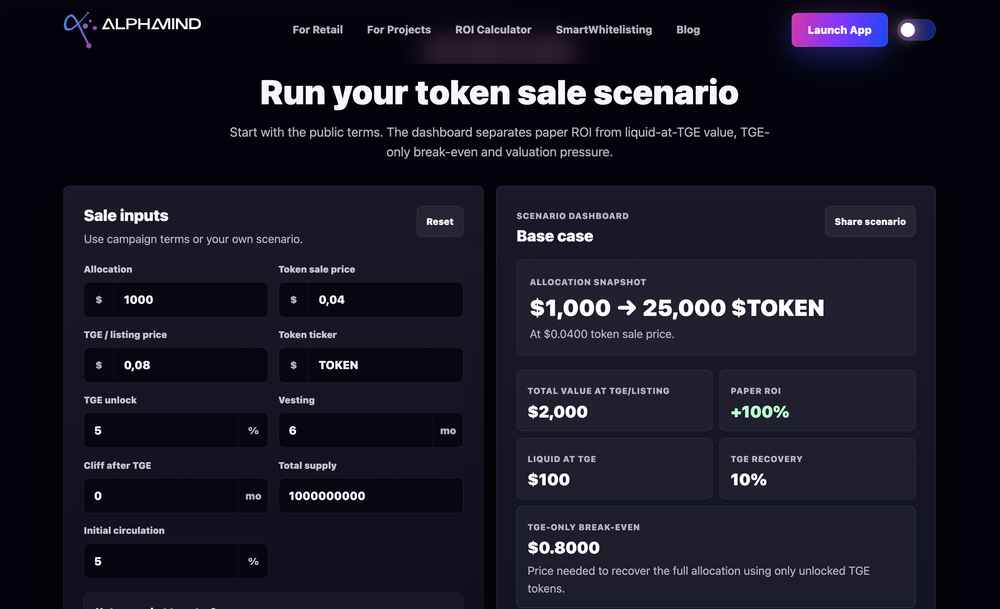
A token sale ROI calculator is an essential tool for budgeting and forecasting. It estimates potential presale and post-launch outcomes by combining your allocation size, token sale price, TGE unlock percentages, vesting duration, and total token supply.
For a Web3 startup, the most important output is not your theoretical profit on paper. The metrics that truly matter are your liquid value at TGE and the exact price your users need to break even. AlphaMind’s calculator bridges the gap between abstract token design and practical market survival by modeling:
- Vesting Terms: Cliffs, lockups, and linear emission schedules.
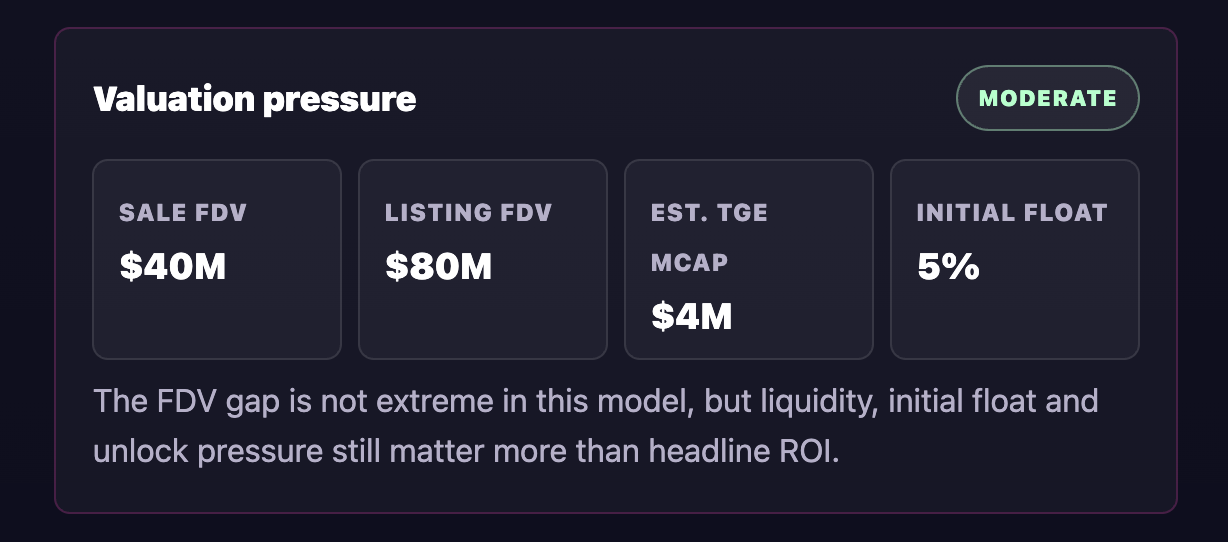
- Valuation Pressure: Sale FDV, listing FDV, and estimated TGE market cap.
- Liquidity Realities: Paper ROI versus actual liquid-at-TGE value.
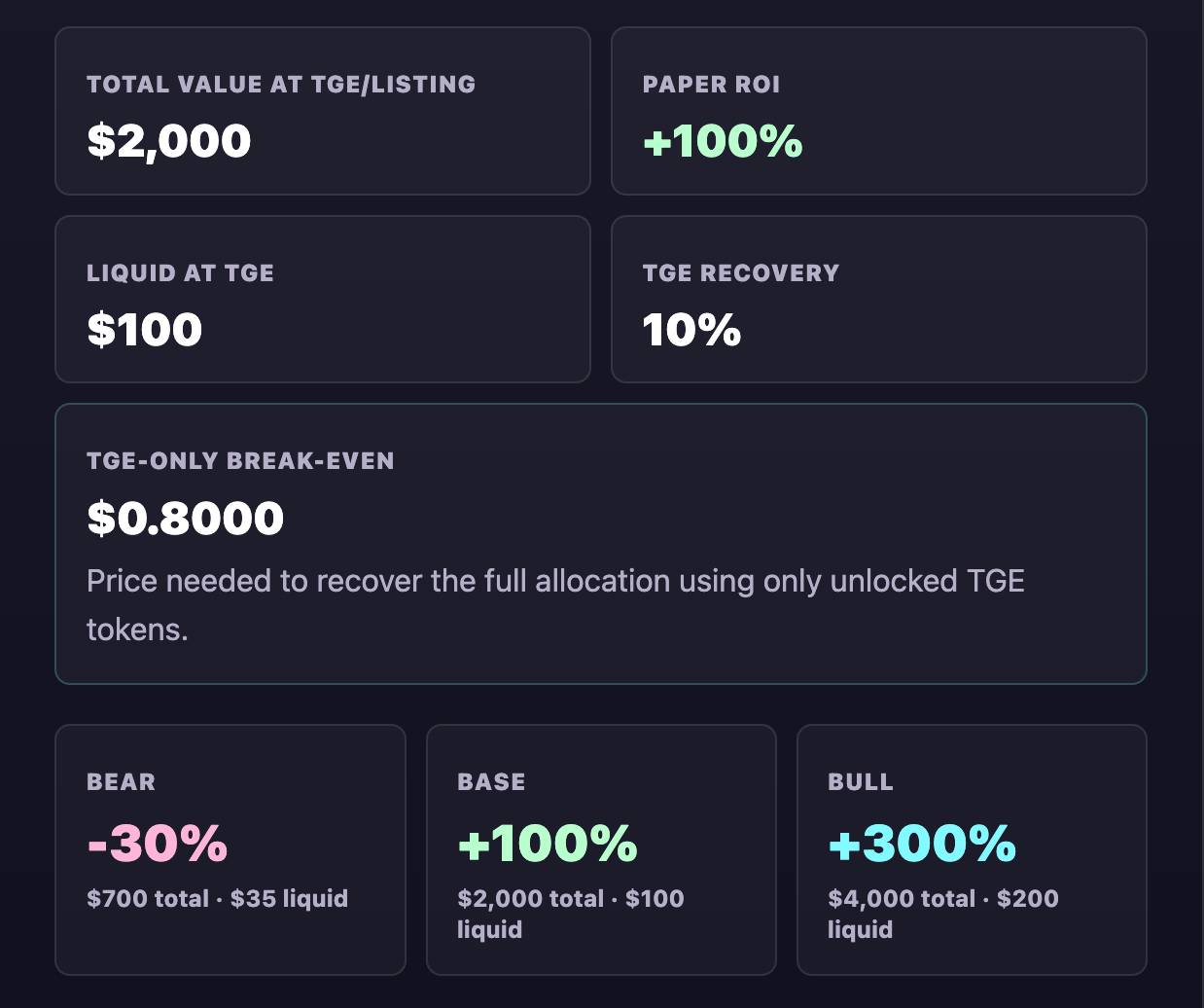
To better understand how these metrics interact under real market conditions, look at the detailed breakdown in the table below:
Why Paper ROI is a Dangerous Illusion
Paper ROI shows the value of your full token allocation at a modeled price, while liquid ROI shows the exact amount that is actually unlocked and sellable at launch. These numbers are rarely the same.
Imagine you secure a $1,000 allocation at a $0.05 token sale price, giving you 20,000 tokens. If the token lists at $0.10, your spreadsheet says your allocation is worth $2,000, which looks like a fantastic 100% paper ROI. However, if your tokenomics structure only unlocks 20% at TGE, you only have 4,000 liquid tokens at launch. At the listing price of $0.10, your liquid portion is worth just $400. While your paper ROI is technically up, your actual TGE recovery is only 40%.
For a startup trying to manage marketing budgets and operational costs, confusing paper growth with liquid cash flow can lead to catastrophic financial planning errors.
Stop Guessing Your Token Performance
Before you publish your whitepaper or pitching to VCs, run your numbers through the market. Visit the AlphaMind Token Sale ROI Calculator to test your vesting schedules for free.
Real-World Use Cases: How Smart Founders Use Data to Win Trust
We built this simulator to help Web3 builders see around corners and protect their limited development funds. Here is how active crypto startups, are using it right now to de-risk their launches:
1. Fixing Tokenomics Before It Is Too Late
One Web3 founder was just days away from launching their public token sale when they decided to test their numbers in our simulator. The visual data shocked them because their proposed unlock schedule would dump over 25% of the total token supply in the first two months.
In a bearish market scenario, this would have completely nuked their token price and destroyed community trust instantly. They immediately reworked their vesting terms, balanced their emissions, and saved their project from a launch-day disaster.
2. Securing Capital from Strategic Investors
When you sit across the table from a venture capitalist or a major angel investor, showing a generic spreadsheet is not enough. Imagine saying, "Here is exactly how your ROI unfolds month by month based on our tokenomics data." This level of transparency changes the entire conversation from blind speculation to strategic alignment. Serious capital wants to see that you are planning for project survivability, not just temporary launch hype.
3. Passing Launchpad and Exchange Due Diligence
With strict compliance and shifting global standards, top-tier launchpads and crypto exchanges are tightening their due diligence. One project recently shared that a major launchpad initially passed on them, but changed their mind after the founders added a detailed simulator snapshot to their data room. The modeling showed a sustainable emission schedule, a well-balanced unlock curve, and clear breakeven timelines, proving the team was serious about long-term growth.
When the Simulator Signals Caution
A simulation tool does not tell you if your project is good or bad, but it clearly flags where your financial assumptions are fragile. You should be highly cautious when:
- The project's FDV is unsustainably high for its current development stage.
- The TGE unlock percentage is dangerously low while the listing FDV is bloated.
- Your vesting periods are exceptionally long, and your team's operational budget depends too heavily on token sales rather than actual product revenue.
- The token price required to hit a TGE-only break-even point is completely unrealistic compared to current market benchmarks.
Final Thoughts
You do not need to hire expensive tokenomics consultants to build a sustainable Web3 project. You simply need tools that show you the truth about your numbers.
Before you launch your next fundraising campaign, pitch to a VC, or lock in your vesting smart contracts, plug your figures into the simulator and see what your model looks like under the hood.
Smart founders do not just dream big, they plan smarter to protect their runway.
Ready to test your token model?
Check your vesting logic, calculate your FDV, and optimize your launch strategy today. Go to the AlphaMind Token Sale ROI Calculator and ensure your project is built to survive.
FAQ
What is the difference between paper ROI and liquid ROI?
Paper ROI represents the theoretical value of your entire token allocation based on the current market price. Liquid ROI refers specifically to the value of the tokens that are unlocked and accessible to trade at any given moment, such as at the TGE.
Why does fully diluted valuation (FDV) matter for a startup budget?
FDV shows the total implied valuation of your network if all tokens were in circulation. If your FDV is too high at launch, it creates immense selling pressure during future unlock events, which can devalue your treasury and damage your operational budget.
What is TGE-only break-even?
TGE-only break-even is the specific token price required to fully recover your initial allocation cost using only the tokens made available at the launch event. This metric helps founders understand how much price pressure their token carries on day one.
Is the AlphaMind ROI Calculator free to use?
Yes, the calculator is completely free to use. It requires no wallet connection, no sign-up, and no sensitive data, making it a safe and accessible tool for any Web3 startup or crypto investor looking to model token scenarios.
Read also:
 Nelli Orlova
 InnMind
 InnMind